Swamiji on mind-management from different perspectives.

Swamiji asks which is the first kind of fear, and Premanandaji's answer is Adhyatmika ashanti [restlessness, anxiety] – self-inflicted or bodily fear.
Swamiji explains some of the criteria which might cause bodily disruption – including poor diet, lack of the right kind of exercise, karma, etc. Swamiji also touches on bhastrika – a very beneficial form of Pranayama – but which when performed incorrectly or by the wrong people, or at the wrong time, can cause significant disruption to the individual.
Some practical advice is given here by Swamiji, on avoiding foods which will overheat the body, and increases sensuality, vs. noting the wisdom of the Rishis from thousands of years ago, about food that will aid in the development of sattvic characteristics, and a calm mind.
There are some fascinating insights here on the obsession of some people with ingredients in a dish, who cooked it, where, how and so on. And then deciding on whether they'll eat it or not. But, says Swamiji, we too often ignore the more subtle components of the food, which were highlighted by Sri Adi Shankara. In which he spoke and taught about the 'food' that we imbibe or 'eat' through the senses. Says Swamiji: The highest food – the subtlest food – is thought or thoughts.
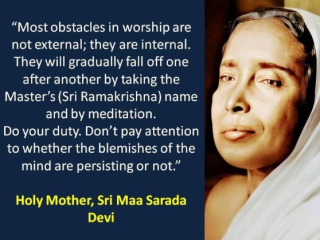
Swamiji illustrates the subtlety and danger of sensual thoughts arising through a variety of stimuli. Quoting Holy Mother Sri Sarada Devi, when speaking to monks, telling them to refrain even from turning over with a foot, a statuette lying on the ground.
Swamiji emphasises how easily a simple event or activity can invoke a damaging thought. Swami says that we need to be vigilant, and monitor thoughts that will either entangle us in worldly life, or free us.
He wraps up the homily by saying we all too easily take things for granted, or perhaps it's because familiarity has entered the situation? So matters are no longer taken as seriously as they were, when we first started out on the path.
To listen to these wise words, please click on the link below. Jai Sri Ramakrishna!
Duration 10:27
NEW! For a fresh daily reading recorded and transcribed by Team Radha Ma and Brother Tim, Click HERE.
The original audio recordings of these posts were made by close Ramakrishna Centre of South Africa and Swami Shivapadananda devotee, Mother Radha. The audio editing and noise reduction of the original 1970s-onwards tapes, has been lovingly engineered, over many years, by her son and our dear gurubhai, Brother Tim. May Sri Ramakrishna and Swamiji bless them both.
Admin tip: Underlined words are links. If you click on them, they'll take you to an explanation of the particular word or term. [In these overviews, Admin comments are typically in a smaller green font, and square bracketed, like this statement.]
Dear reader, if you spot typos or or other errors, please feel free to email the site admin on info@imbizo.com with your suggested correction/s.
Context: As always, care should be taken to remember that what Swamiji was saying, may have been very specific to the needs of people with him at the time. Please bear this in mind.
Links to our Guruparampara (spiritual lineage) organisations, which will broaden your knowledge base: Ramakrishna Math and Mission and our alma maters, the Ramakrishna Centre of South Africa and the Sri Sarada Devi Ashram in Durban. The Ramakrishna Centre of Johannesburg is also active in Gauteng province in South Africa.
There are various publications [The Gospel of Sri Ramakrishna etc.] which you can download at no charge, from the Ramakrishna Centre of SA website page, HERE.