Swamiji sounds yet another warning about permanent pranayama damage.
Swamiji once again cautions us against doing pranayama without guidance and monitoring by an adept. He uses the analogy of an electrical distribution box and how dangerous it is, to start tampering with wires or connections without correct knowledge of electricity.
Here's the terrifying part: Swamiji says that it's quite possible to disrupt nadis [subtle spiritual nerve channels] or even completely burn them out, beyond repair, for this entire birth.
Swamiji explains how excessive anything leads to a breakdown of physical or mental health. And that we need to watch how the body reacts to our practises. If it reacts badly, then take it a little easier. Make it stronger, and then continue.
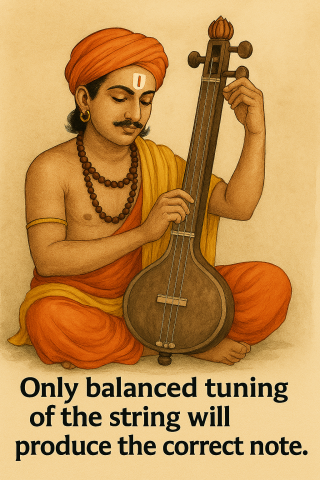
Spiritual practise carried to extremes can cause people to 'go off their head – I've seen many people go off their head' says Swamiji. And then they'll blame the Guru. The Guru tells them to do something once and they go and do it ten times. So, excess is the enemy. [Swamiji so often reminded us about the tuning of strings on a musical instrument. It has an optimal state of tension in which it will produce the correct note. Too tight and the pitch will be higher than desired. Too slack and it won't be able to produce the right note either. The Buddhists refer to to this as the 'Golden Mean' in everything.]
Swamiji explains how the Guru has been through all of that experimentation, and knows from experience that if he says do one mala of japa and we do ten, that we'll quickly tire and 'get fed up' as Swamiji puts it.
Swamiji says that when we go to a doctor, we're playing with our bodies – placing trust in the doctor to do or recommend the right thing. But when going to a Guru, we're playing with our souls – and if they're unqualified, we can land up in what the Isha Upanishad refers to as, 'blinding darkness'.
Swamiji gives simple guidelines for achieving a state of calmness or improved physical and mental health. What comes through in this lesson is gentleness and moderation. Don't force anything. If you do so, particularly when unwell, you'll only make matters worse.
Swamiji wraps up the homily by giving advice on meditation posture, citing a fun response from a guest speaker, to a devotee asking 'which posture is best for meditation?'
As Swamiji says, people in India sit in certain postures from early childhood, so they're comfortable when cross-legged on the floor. In the west, we may not be used to sitting like that. So whichever posture is comfortable and conducive to the head, neck and spine being in a straight line, and in which blood circulation is not disturbed, is best for the individual. This entire lesson is packed with practical, immediately implementable advice.
To listen to the words of wisdom, please click on the link below. Jai Sri Ramakrishna!
Duration: 08:54
For the free-to-read, draft 394 page expanded version of 'A Life Lived For Others'.
Click here: → Swamiji's biography
You may need to install a PDF reader on your phone if that's where you'll be reading the book.
The original audio recordings of these posts were made by close Ramakrishna Centre of South Africa and Swami Shivapadananda devotee, Mother Radha. The audio editing and noise reduction of the original 1970s-onwards tapes, has been lovingly engineered, over many years, by her son and our dear gurubhai, Brother Tim. May Sri Ramakrishna and Swamiji bless them both.
Admin tip: Underlined words are links. If you click on them, they'll take you to an explanation of the particular word or term. [In these overviews, Admin comments are typically in a smaller green font, and square bracketed, like this statement.]
Dear reader, if you spot typos or or other errors, please feel free to email the site admin on info@imbizo.com with your suggested correction/s.
Context: As always, care should be taken to remember that what Swamiji was saying, was often very specific to the needs of people with him at the time. Please bear this in mind.
Links to our Guru Parampara (spiritual lineage) organisations, which will broaden your knowledge base: Ramakrishna Math and Mission and our alma maters, the Ramakrishna Centre of South Africa and the Sri Sarada Devi Ashram in Durban. The Ramakrishna Centre of Johannesburg is also active in Gauteng province in South Africa.
There are various publications [The Gospel of Sri Ramakrishna etc.] which you can download at no charge, from the Ramakrishna Centre of SA website page, HERE.
The picture in this post was created using prompts to Microsoft Copilot Artificial Intelligence – AI.