Swamiji explains how Rishis are role-models for us.
How does the sadhaka [spiritual aspirant] try to realise this, asks Swamiji. A sadhaka should always be very, very serious – inside – especially where his or her spiritual exercises – called sadhana – are concerned.
If we don't treat these exercises seriously, and at the same time sacredly, then we will miss the goal. Any mind that enjoys unnecessary fun, frolic and laughter – the word 'unnecessary' should be underlined – that person's mind becomes fickle.
Unknown to that person, the mind becomes weak. It has no principle or 'spine' to stand on. All of us have a spine to stand on [physically]. And sadhana's 'spine' is principles.
These principles were discovered by the great Rishis [sages, seers, saints of yore (old)]. Swamiji goes on to explain the lives, roles and scientific nature of the Rishis. Listen to what Swamiji has to say about our easy modern lives, by comparison.
Today's scientists explore the physical. They ignore the mental and spiritual worlds. The word Rishi itself, means 'seer of truth'. They were the knowers of truth of the physical, mental and spiritual. Not only the spiritual.
Hear what Swamiji has to say about the versatility of a truly holy person. It's an eye-opener of note. They are models of adaptation and excellence in whatever they do – or could be asked to do.
However, Rishis are indifferent to that which is not permanent. Swamiji explains why. It's fascinating. And a wake-up call for us. He provides a superb differentiator, between theory and actual experience.
Swamiji goes on to talk about what we as sadhakas must pay attention to, and how we should approach what we do, by way of spiritual practise.
He draws together the threads of this homily, by talking about the austere, spartan conditions under which the Rishis lived. Designed to 'lighten the burden of the mind' and maintain vairagya [dispassion].
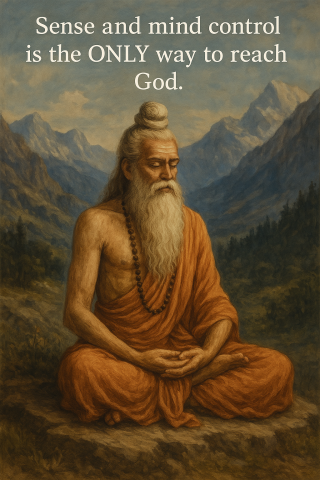
They had only the bare necessities of life. They did this to get and keep the senses and mind under control. Getting the senses and mind under control is the ONLY way to reach God says Swamiji. There is no other way.
To be inspired by this wonderful message, please click on the link below. Jai Sri Ramakrishna!
Duration: 09:12
For the free-to-read, draft 394 page, expanded version of 'A Life Lived For Others'.
Click here for: → Swamiji's biography
You may need to install a PDF reader on your phone if that's where you'll be reading the book.
The original audio recordings of these posts were made by close Ramakrishna Centre of South Africa and Swami Shivapadananda devotee, Mother Radha. The audio editing and noise reduction of the original 1970s-onwards tapes, has been lovingly engineered, over many years, by her son and our dear gurubhai, Brother Tim. May Sri Ramakrishna and Swamiji bless them both.
Admin tip: Underlined words are links. If you click on them, they'll take you to an explanation of the particular word or term. [In these overviews, Admin comments are typically in a smaller green font, and square bracketed, like this statement.]
Dear reader, if you spot typos or or other errors, please feel free to email the site admin on info@imbizo.com with your suggested correction/s.
Context: As always, care should be taken to remember that what Swamiji was saying, was often very specific to the needs of people with him at the time. Please bear this in mind.
Links to our Guru Parampara (spiritual lineage) organisations, which will broaden your knowledge base: Ramakrishna Math and Mission and our alma maters, the Ramakrishna Centre of South Africa and the Sri Sarada Devi Ashram in Durban. The Ramakrishna Centre of Johannesburg is also active in Gauteng province in South Africa.
There are various publications [The Gospel of Sri Ramakrishna etc.] which you can download at no charge, from the Ramakrishna Centre of SA website page, HERE.
The image in this post was generated through prompts to Microsoft Copilot AI (Artificial Intelligence).