Swamiji speaks on different dharmas for monastics and householders.
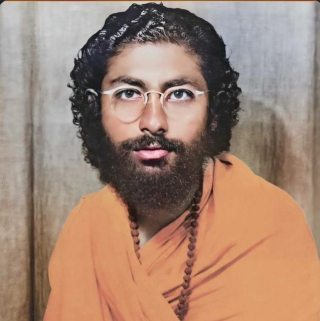
'I sought Thee without, and found Thee not. I sought Thee within, and found Thee everywhere.' – Swami Nischalananda Puri (pictured) Swamiji's beloved Guru and our Gurudev.
Swamiji quotes a Gujarati song, about the world being a dark place. A confined space. He says, don't waste time trying to walk about in the confined space. If we really seek God, where will be the time for anything else?
Encapsulated in an interesting thought: It's like 'A thing, looking for a thing.' So, looking for itself. You don't have to go out and seek for this. It's just the opposite. Every time you reach out, you're missing the point. So stop reaching out. That is the Maya [the delusional hijack – the veil over the full truth].
You're so much in the habit, it's become your nature. Stop reaching out. Just stop! How can a drunk man walk to reach somewhere specific? He can't. He's drunk. Swamiji starts singing 'Om Tat Sat, Om Tat Sat, Om Tat Sat Om.'
[This following approach is directed at the monastics – as you'll hear Swamiji clearly say]. You must know that you are the soul. Separate the body from it. How to do it? Keep thinking, 'I am not the body.'
Swamiji describes how he used to consciously make himself aware, for example, that his eyes were doing the seeing – not the 'real' him – but his eyes. So becoming aware of the separation eventually becomes entrenched thinking.
But, says Swamiji, this is also the time to be vigilant. Because as one becomes conscious of the soul – which is who we really are – being separate from the body, objects of love or attachment from past lives, will surface. Sheer willpower is required to overcome this Maya.
Swamiji says this is NOT an instruction for householders. Because it would impede their ability to execute their duty, family and other worldly responsibilities.
[There's some serious background noise in this recording (despite our Brother Tim's best efforts to filter it out) – and it's worse at this point. But there are some real pearls here, so please just try to listen in a quiet environment.]
It sounds like Swamiji is explaining why it's impossible to describe samadhi or a super-conscious state. [No sage, saint, Rishi or other holy person has ever been able to.] It's in another state of vibration or supremely elevated consciousness, and the 'vocabulary' to explain it at our level does not exist. It cannot and does not describe it. [Which is why the Jnanis and the scriptures on monism or Advaita Vedanta have to resort to saying, 'Not this, not this – neti, neti.] The only way for it to be understood is for the individual to reach that level and experience it for themselves, say the Wise Ones.
The conclusion of this homily is that the householder should not try to go the non-dual, monistic or Advaitic route, but rather worship a deity as their dharma. Their role in this life is not the same as that of the monastics. [It's very important to clarify that Swamiji always stressed that we should all have the greatest respect for the householder or grihasta ashram or state. It is in no way inferior to any other of the life principles or stages.]
Other posts on this site, both transcribed or actual recordings, will attest to that. [To the extent that Swamiji once said to me, 'This time (in this birth) I have come for the (benefit of) Householders.] Says Swamiji, Don't imitate [another stage of life] and think 'That is higher.' No. Take it step by step. [Executing our dharma for this birth.]
To be reassured by this gentle context, please click on the link below. Jai Sri Ramakrishna!
Another new development with Sri Ramakrishna's grace: Below is a link to an AI (Artificial Intelligence) word-for-word audio transcript of this audio clip. No background noise! Instead of reading a typed transcript, you can now listen to one, if it's easier for you.
Duration: 08:58
Click here for the Flipbook version of: → Swamiji's biography
It's a free-to-read, draft 396 page, extended version of 'A Life Lived For Others. No need to install a PDF reader. It'll work in your present browser.
However, if you'd prefer a straight-up PDF version, please click HERE.
Dear Devotee, if we use the term 'He or he', when referring to Swamiji, it's not impolite or disrespectful. It's to minimise the repetitiveness of saying or writing 'Swamiji' too many times.
The original audio recordings of these posts were made by close Ramakrishna Centre of South Africa and Swami Shivapadananda devotee, Mother Radha. The audio editing and noise reduction of the original 1970s-onwards tapes, has been lovingly engineered, over many years, by her son and our dear gurubhai, Brother Tim. May Sri Ramakrishna and Swamiji bless them both.
Admin tip: Underlined words are links. If you click on them, they'll take you to an explanation of the particular word or term. [In these overviews, Admin comments are typically in a smaller green font, and square bracketed, like this statement.]
Dear reader, if you spot typos or or other errors, please feel free to email the site admin on info@imbizo.com with your suggested correction/s.
Context: As always, care should be taken to remember that what Swamiji was saying, was often very specific to the needs of people with him at the time. Please bear this in mind.
Links to our Guru Parampara (spiritual lineage) organisations, which will broaden your knowledge base: Ramakrishna Math and Mission and our alma maters, the Ramakrishna Centre of South Africa and the Sri Sarada Devi Ashram in Durban. The Ramakrishna Centre of Johannesburg is also active in Gauteng province in South Africa.
There are various publications [The Gospel of Sri Ramakrishna etc.] which you can download at no charge, from the Ramakrishna Centre of SA website page, HERE.