Daily Readings 87. Swamiji gives rich advice on a range of topics. Read, absorb and implement.
Taken from Mother Radha’s notes, written at Swamiji’s feet.
Simple Pranayama is alternate nostril breathing to the count of [in for] 2, [hold for] 8, [exhale for] 4. Do it for half an hour – morning and evening. This is especially good for intellectual and emotional balance. This removes exhaustion and leads to calmness and joy. Bhramari breathing is like a bee’s hum, is very slow and very relaxed.
It takes tremendous courage to unite mind and speech – especially when it is to one’s own discredit.
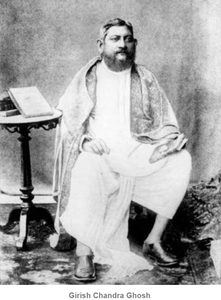
Complete surrender to God is more binding than observing strict disciplines. Master [Sri Ramakrishna] said to Girish Chandra Ghosh [*see below for more on Girish], ‘Always say, ‘I will do it if God wills.’ Meaning, you consciously surrender to God’s will – and think of Master every moment. It takes time to eradicate past samskaras. But in Girish, faith and love were so intense that the transformation was brought about very quickly.
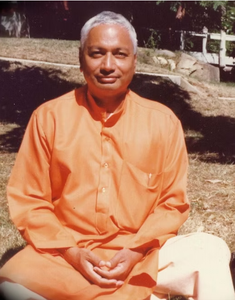
[Editorial note: Swami Venkatesananda Saraswati, Head of the Divine Life Society [DLS] in Mauritius was a close friend of the Ramakrishna Centre of South Africa. He was guru to our Mother Radha. We loved him dearly. He had a puckish sense of humour and when he mentioned ‘samskaras’ he would teasingly say, ‘They’re some scars from previous births.’
Our beloved Swamiji and Mother Radha flew to Johannesburg when Swami Venkatesananda left the body. Our Swamiji conducted the cremation funeral rites along with Swami Nishreyasananda, head of the Ramakrishna Mission in Zimbabwe.]
[Lord] Ganesha’s mantra is Om Vigneshwaraya Namah.
I am tired of lukewarm devotion. Lukewarm devotion should get lost in the heat of the bhakti you generate in your hearts for the Ideal. Many of you have joined the ashram because of love of the Deity. Many of you join the ashram to serve humanity. There is no genuine work without real devotion to the Ideal.
[* About Girish Chandra Ghosh: Born of pious parents on February 28, 1844, Girish grew up as a lively carefree soul. He inherited from his father a sharp intellect and a pragmatic approach to life, and from his mother a love for literature and devotion to God. His grandmother introduced him to the rich heritage of India’s epics and mythology.
At the threshold of youth, Girish started drifting into drunkenness and debauchery. Yet side by side with his perverse behaviour, he would raise money to help the poor.
Because of his wayward nature, he could not complete his school education. But he was a genius and a voracious reader. He studied several subjects and gained vast knowledge in English literature, Western philosophy and science. His prodigious creativity found expression through writing and acting. He wrote many well-known plays, and acted in most of them. The songs which he wrote are popular even today.
In his case, it was not he who first sought Sri Ramakrishna, but it was the Master who sought him first. On seeing Sri Ramakrishna for the first time, he thought that the Master was a fraud. Only in his fourth meeting did he feel the wonderful attraction of Sri Ramakrishna. Through Master’s influence, he slowly gave up his haughtiness, rudeness and arrogance. The Master asked him to have faith in order to get rid of crookedness of heart.
Under the Master’s loving care, Girish started realising that the Master would not condemn him for his shortcomings. One great virtue that Girish had was his steadfastness to Truth and total lack of hypocrisy. Finally, one day Girish surrendered completely to the Master. He gace Master his ‘power of attorney’. Girish’s faith and love were so intense that his life was quickly transformed.
On 1 January 1886, during the Master’s last illness, Girish openly started preaching the Master’s divinity. Many were blessed by the Master after the event. After the Master’s death, he intentionally did not view Master’s dead body, to preserve in his mind his conviction that Master was immortal.
Girish breathed his last on 8 February 1912. His last words were: ‘Master, you have come. Please destroy my worldly intoxication. Victory to Sri Ramakrishna. Let us go.‘]
Swamiji: Never say, ‘That is wrong,’ say, ‘That is good, but there is [or may be] something better.’
A sattvic [balanced, serene] man alone worships God for God’s sake and nothing else, without any motive whatsoever.
Increase your sadhana [spiritual practice] – do not decrease it. You will find this makes a great difference to your sadhana. Just love God without motive. Wherever you are remember God, remember your Deity. Gurudev [Swami Nischalananda Puri, Swamiji’s beloved guru] told me, ‘First say the mantra to your Self, then to God.’ It is hard to understand Gurudev sometimes. He said, ‘First stand in front of the mirror and tell it to your Self.’ At first, you think you know it all and the others know nothing. Then you find it is you who knows nothing. Everything you do here at the ashram is sadhana [spiritual practice]. There is no place for play. If you stick to it, you are sticking to your ideal. Every thought is a form of God.
[To a beloved devotee]: Think of me as breath – with each breath I enter into you.
A sannyasi’s life is a life of sacrifice. Be good and you will do good.
Do not be attached to results – that is all.
On danda and kamandalu: A sannyasi’s staff [danda] represents the intellect, discrimination, viveka. The kamandalu [water gourd/pot] represents the heart, dispassion, vairagya.
Underlined words are hypertext links to clarification, explanation or other sources. Just tap on them.
The free-to-read or download, 396-page Flipbook version of Swamiji’s biography, ‘A Life Lived For Others‘, is available by clicking HERE. If you’d prefer the PDF version, please click HERE.
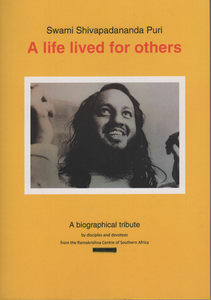
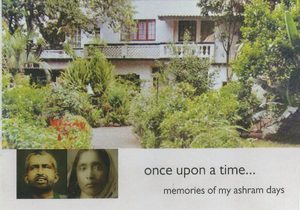
For our gurubhai Atmaprakash Kramer’s beautiful pictorial ‘memoir’ booklet of the Ramakrishna Centre of South Africa, Avoca Ashram, please click HERE.
There’s also a Facebook site for Swamiji’s posts now. They feature newer readings published more recently. Click HERE to view.
These recordings or the excerpts from them, were made from the early 1970s onward, by Mother Radha, a close devotee of Swamiji’s and edited for uploading here by our gurubhai and her son, Brother Tim. Please be mindful that what Swamiji was saying may have been specific to those with him at the time.