Disc 136 Track 4. Swamiji says: If you take God’s name sincerely, with faith and love, even if you make mistakes, God Himself will guide and protect you.
To listen to Swamiji speaking, please fully open the post and then click HERE.
Swamiji links the first few sentences of this post to the previous Disc 136 track 3, on Bilwa Mangal. Swamiji explains what the original concept of Sati [outlawed in 1829 by the British Raj] was intended to be.
But how that changed even further with the advent of Sri Ramakrishna. When Master left his body in 1886, Holy Mother Sri Sarada Devi removed her bangles and was going to wear the then traditional pure white [no coloured border] sari of the Hindu widow, when Master appeared to her and asked, ‘What are you doing?’ This was a wonderful insight for all of us, because Master explained that he hadn’t ‘died’, but had in fact simply ‘passed into another room’ as it were. ‘From birth in a gross, physical, room, I am born in another room – in your heart.’ [A glorious and comforting concept.]
Harking back, Swamiji says that Bilwa Mangal’s life continues to be an inspiration to bhaktas of today. If you take God’s name sincerely, with faith and love, and even if you happen to make some mistake, God Himself will guide you and protect you.
But one thing you must be careful of, says Swamiji, don’t ‘use’ God for the wrong thing. Call on Him for the right thing. Swamiji gives an amusing hypothetical example of two devotees of Maha Kali, each praying for the annihilation of the other. Swamiji says, ‘No! Mother does not kill anybody. It’s your own karma that kills you.
The highest way is to say, ‘God bless everyone, and let me not do any bad karmas [deeds]’. Swamiji repeats that the highest prayer which had been shared with him in his life, was the first verse of the [Sanskrit peace] mantra that begins with ‘Om Sarvesham Svastir Bhavatu,’ [see below] which means ‘May there be well-being in all.’
Om Sarvesham Svastir Bhavatu, Sarvesham Shantir Bhavatu, Sarvesham Poornam Bhavatu, Sarvesham Mangalam Bhavatu, Om Shanti Shanti, Shantih.
Meaning: Sarvesham: In all, for all beings.
Svastir Bhavatu: May there be well-being, happiness, and good health.
Shantir Bhavatu: May there be peace.
Poornam Bhavatu: May there be fulfillment, completeness, or perfection.
Mangalam Bhavatu: May there be auspiciousness, prosperity, or success.
Says Swamiji: If man can just think that continuously, what else can God do, but to work through that instrument, because He Himself wishes that [peace] upon the whole world.
Here we find that a sinner [Bilwa Mangal – for the full back story, read HERE] – whose birth was high but whose actions were low, by the word of a public woman [prostitute], an evil was turned by the grace of God, into satsanga.
But then, after following God’s road, that past impression [vasanas/samskaras] surfaced, but yet again it was through God’s grace that he blinded his own eyes. And even people with eyes don’t meet [see] God, but here, Bilwa Mangal, without physical eyes, did. The meaning of this is very simple. When you close your eyes to the outer world, the inner eyes open to God. Having your eyes, you do not see. So, close your eyes and you will see Him within.
[Bhakt] Prahlada said that God is ‘not only in human beings, but even in the worst of everything.’ [That’s the meaning of omnipresence – no exceptions, exclusions. Everywhere means everywhere].
Swamiji says [that with the right attitude and lifestyle] you don’t need to go and look for satsang – satsang will come to you. If you can only keep your mind pure, full of love for God, and be sincere, you will be the flower that will fully blossom and the bees, called devotees, will flock to you. Says Swamiji: May that blessing become part of us. May we also, though tempted by our past karmas now and then to do wrong, may God save us, take away our focus on physical eyes, and replace it with spiritual eyes.
Swamiji quotes the first line from the Isha Upanishad – ‘Isa vasya idagung sarvam…’ – it means God dwells in all of this – even in space.
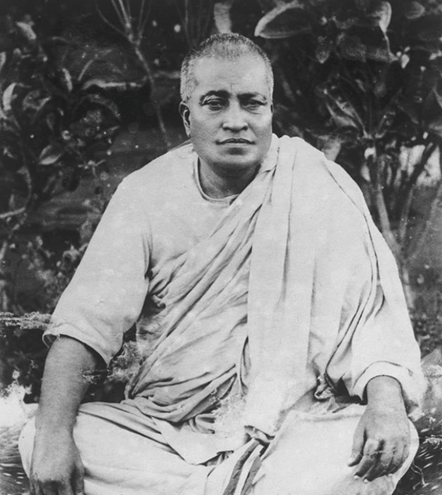
Someone went to [Swami] Shivananda Mahapurushji, [pictured above] Sri Ramakrishna’s direct disciple, and asked, ‘Can I use water as a symbol of God?’ Mahapurushji laughed, and asked, ‘Why only water?’ Use space as the symbol of God. Because everything is in that space [around us and beyond], the sun is in that space, the moon is in that space, water too, is in that space. And they also disintegrate and vanish into that space. So the best symbol of God, is space itself. It contains everyone, and yet nothing can ever contain the whole of space.
Swamiji thanks our dear Gurubhai, Dharambhai’s father and mother for giving the devotees the privilege of being able to sing about God’s glories [by the sound of it, at a satsang, prayer service or event hosted by them]. Swamiji thanks the rest of the family, too, and says, ‘Blessed is the father and blessed is the mother whose children take to God.’
Swamiji switches following that satsang, to answering a question raised about whether God is great or man is great? The answer he says, is that the bhaktas are great. Because they keep God in their hearts. Whoever sincerely takes God’s name, they are the greatest. Swamiji gives some examples of spiritual luminaries or even gods who didn’t have a defined ‘caste.’ Says Swamiji, bhakti [devotion] is the most important thing. If you have bhakti – God is yours. Other things are meant to guide you towards God.
Swamiji wraps up this segment by saying that we tend to worship in a particular way, because we’re attracted by the form [of the deity – Ishta Devata]. Sri Krishna told Arjuna to go and worship Mother Durga before the Kurukshetra battle. And yet Krishna is himself the same [Consciousness] as Mother Durga.
They say that when Lord Rama was unconscious, Mother Kali came and did the work. Swamiji says that regardless of name or form, everything is ‘Its’ [that is, the Un-Named’s] power. He [God] Himself knows what He is. He takes the form of Rama, we worship him. He takes the form of Durga, we worship Him. He takes the form of Krishna we worship him. We worship that ‘good’ part, the divine part, that which is the real God in everyone.
Swamiji then leads the devotees in a short meditation saying, ‘Banish all thoughts inside of you. Concentrate fully on your deity. Feel that your deity is all-powerful and all love and all knowledge. Just for a few seconds, let your mind disappear completely.’
The free-to-read or download, 396-page Flipbook version of Swamiji’s biography is available by clicking HERE. If you’d prefer the PDF version, please click HERE.
These recordings or the excerpts from them, were made from the early 1970s onward, by Mother Radha, a close devotee of Swamiji’s and edited for uploading here by our gurubhai and her son, Brother Tim. Please be mindful that what Swamiji was saying may have been specific to an individual or a group of people with him, at the time.