Disc 136 Track 7. Swamiji gives some extraordinary, practical advice on seeing good in others.
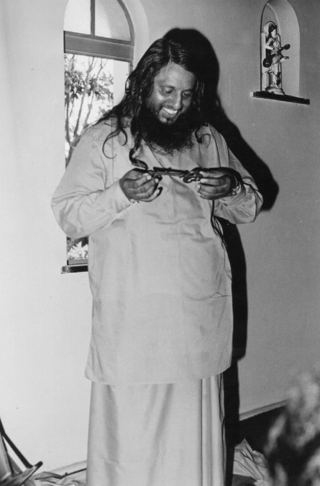
To listen to Swamiji speaking, please fully open the post and then click HERE.
[Note: We’ve used voice isolator AI on this clip, because Swamiji was speaking softly in the latter part of it, and there was considerable extraneous noise.]
The clip gives some extraordinary, practical advice on first starting to see good in the holy as we perceive them to be [no matter what they do], and then deliberately seeing only the good in everyone – even those we might [in our ego-centric states] consider to be ‘sinners’ or ‘less than’.
Swamiji says that if one keeps thinking like this, God is revealed and even other people that we might not like or respect, are ‘bathed’ in that vibration of good. So both we and they, are being transformed.
Swamiji quotes the transformation of Girish Chandra Ghosh [the famous and licentious Bengali playwright] because Sri Ramakrishna saw only the divine in him and many other people. Sri Ramakrishna never saw the ‘bad’ even in prostitutes. Sri Ramakrishna saw only the divine in these women and addressed them as ‘Ma’. And they were transformed.
[There are equally touching stories from the life of Holy Mother Sri Sarada Devi in which the ‘fallen’ women (as they self-described) – actresses – from Girish’s Star and three other theatres, who were ashamed to enter the Holy Mother’s presence, but Mother made all welcome and showered only love on them.]
So, says Swamiji, it is we who must be very careful about what we think of others. What you think you become. And it’s not only what you become. You help others to become that too. That is the whole truth and philosophy [of transformation].
The only way is love, says Swamiji. Love [bhakti] and knowledge [jnana] are one. You love God by seeing an object and knowing that it is God [in that form]. Knowing is knowledge [jnana]. Loving is bhakti. The possessor and the possessed [by love] are one.
In a second portion of this clip Swamiji speaks briefly about meditation. Swamiji says that we read good books or watch good movies and the mind is happy. Yet it’s not happy when we need to meditate [do sadhana].
Moving on, lust, says Swamiji, I interpret as ‘want’. Greed, I interpret as ‘more than I need’. Lust is desiring certain things. But is it the rightful desire? If it is a desire that will help me to realise God, then, although it’s a desire, it’s not lust.
The highest lust or bondage is having woman or man. So, any desire that binds you, is lust. Any. Unless that desire helps you to remember God. Greed, Swamiji explains, is for example, wanting five asanas – seats or chairs. If you can only use one says Swamiji, what are you going to do with the rest of them? Someone else would have enjoyed sitting on one of them. If you want a coat, how many do you need? One is enough. Some poor person would enjoy it.
Accumulation and possessing it, goes together. Lust and greed go together. So lust and greed means this to me.
The free-to-read or download, 396-page Flipbook version of Swamiji’s biography is available by clicking HERE. If you’d prefer the PDF version, please click HERE.
These recordings or the excerpts from them, were made from the early 1970s onward, by Mother Radha, a close devotee of Swamiji’s and edited for uploading here by our gurubhai and her son, Brother Tim. Please be mindful that what Swamiji was saying may have been specific to an individual or a group of people with him, at the time.