Disc 137 track 5. Swamiji says hearing scriptures has lasting impact when it comes from a qualified spiritual teacher.
To listen to Swamiji speaking, please fully open the post and then click HERE.
Swamiji talks about the three kinds [levels] of chelas [disciples] and how they engage with the Guru. Swamiji goes into depth on the dynamic behind this process or phenomenon.
Swamiji is discussing a very high level of [‘in-tune-ness’] in satsangs. Saying that if he says ‘Raam’ just once, it reverberates in the minds of so many others, even in trees etc. [For interest: Swamiji told us many times that trees can feel.] So we don’t necessarily have to verbalise something externally for it to be ‘heard’, transmitted or have an impact.
Swamiji says other methods of reading or understanding the scriptures etc., will have an impact, but they won’t have the same major impact as it will, when hearing directly from a suitably qualified teacher. Which is why it is said that you have to learn the Upanishads [major Hindu scriptures] from a Guru.
Swamiji explains how he used to listen to things said by Gurudev [his beloved Guru, Swami Nischalananda Puri] and initially regarded them as ‘concepts’. Because Swamiji was looking at it from the viewpoint of his own perspectives and experiences to date.
Swamiji goes into depth about what it really means to ‘Love thy neighbour as thyself.’ He brings a fresh perspective to it, which will be an eye-opener for many of us. ‘Love itself is a spiritual quality’, says Swamiji. Please give yourself the gift of hearing Swamiji fully explaining this.
If we want to understand what law books are saying or teaching, says Swamiji, we must go to a knower of the law. And even then, amongst the lawyers, there are higher and higher resources. Until you get to a judge. Says Swamiji, you may think that you ‘know’. But in reality, you have to go to someone who’s been through the experience. He will tell you the right thing. There’s no ‘thinking’ involved. He knows.
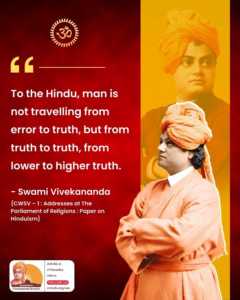
Swamiji quotes Swami Vivekananda: ‘We are not travelling from untruth to truth. But from lower truth to higher truth’ – until we reach the absolute truth. Reading the scriptures on your own doesn’t mean it won’t do any good. It will do good. But it doesn’t mean you have really understood it, like the person with actual experience [realisation] can explain it.
Swamiji has fun with the concept of ‘So long as I live, I learn’, which was said by Sri Ramakrishna. Listen to how Swamiji expands on our limited, literal take on the statement. He cracks up Mother Radha and the devotees by saying, you are without the I [ego] ‘only when you’re dead as a Dudu’, instead of ‘Dodo’. [Swamiji thrilled us with loving merriment with his malapropisms – words which sound like the one intended – but aren’t the ‘right’ one.] I’m convinced it was a spontaneous way of entrenching a point, because it always produced a positive emotional shift in us.]
Tulsidas’ journey to real ‘satsang’ and spiritual development comes under discussion. Paradoxically with him, says Swamiji, it was his lack of sense-control that led to his rapid evolution. Swamiji says it’s important to know your motive for going to Satsang.
Swamiji goes on to say that scripture is a wish-fulfilling [kalpataru] tree. It gives you what you want. It doesn’t impose itself on you. He says: You’ll find that in [Lord] Rama’s family, all were not God-realised. But they also got prosperity, though not ‘spiritual prosperity’ as it were.
If you have the right motivation and attitude and read the scriptures, then you’ll have the right view of it. Because automatically, if you have mind and sense control it means you’ve got faith, you’re doing something right.
Says Swamiji: It’s Patanjali who makes provision for Ishwara, because he says that even without ‘believing’ in God, you can realise the Self and get into samadhi. That’s the most scientific scripture that we have for the modern times. Because it says, ‘Do these things and you will experience it.’ Before that, Swamiji says, ‘Do yama and niyama’ [The moral and ethical precepts of what we must and should not do.] That’s the first thing you have to do.
Swamiji concludes by saying: If a man is lecturing in university, reading scriptures and all of that, but comes home and he’s not practising yama and niyama, he’ll never realise the spirit of the scriptures. Forget it.
The free-to-read or download, 396-page Flipbook version of Swamiji’s biography is available by clicking HERE. If you’d prefer the PDF version, please click HERE.
These recordings or the excerpts from them, were made from the early 1970s onward, by Mother Radha, a close devotee of Swamiji’s and edited for uploading here by our gurubhai and her son, Brother Tim. Please be mindful that what Swamiji was saying may have been specific to an individual or a group of people with him, at the time.