Disc 138 Track 6. Swamiji says we must be ‘sin-seer’ to want to meditate.
To listen to Swamiji speaking, please fully open the post and then click HERE.
[Noisy clip, I’m afraid.] Swamiji is in a fun mood. He’s talking about meditation and the best times at which to meditate. He starts off by saying that you must be sincere. But puns it into ‘sin-seer’ – he says we must first see the sin. That’s the kind of seer you have to become first, he says.
Question from a book [not sure which one]: How can we make ourselves want to meditate? Now you’re asking, says Swamiji, ‘How to get the love of God?’ Go to the holy people. But to go to the holy people you must have the desire. How do you get the desire? Don’t worry about the desire. Just go to the holy man. [You might think] ‘But I don’t like it.’ Just force yourself. Then when you keep going there, you’ll have the desire. Self-effort must be there. Forcing must be there, first. See? Self-effort.
How can we make ourselves want to meditate? Answer: The secret is, doing it! When the mind is concentrated on a subject, interest arises. But it takes time. Once you begin to meditate regularly, you will find that there is joy in the thought of God. Practise, practise.
It’s a very funny thing, says Swamiji, I know that a lot of us in the [Ramakrishna] Centre [of South Africa] only do it in the morning. That’s not right. The evening too, you must do meditation. And not only before going to bed. Sunset and sunrise.
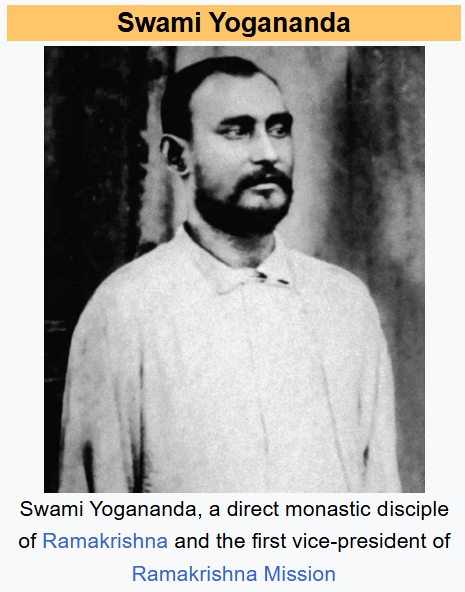
Swamiji relates the story of Swami Yogananda Puri [one of Sri Ramakrishna’s direct disciples] when he was young, and used to slip away to meditate. One day, talking to his [elder] brother about samadhi [superconsciousness], he said to his brother, ‘Show me samadhi.’ The brother said, ‘OK, come to me at twelve o’clock tonight, but don’t bring father.’
They got together at midnight and Yogananda went into meditation. When the sun began rising, the brother got a shock to see that Yogananda was still in a profound meditation. He anxiously went and called his father. The father came and started repeating God’s name into Yogananda’s ears. [A method used to bring a meditation adept or holy person back to a normal plane of consciousness]. When Yogananda came out of the meditation, he was ashamed [embarrassed] seeing his father there, because he didn’t want his father to know about his spiritual practises.
So, says Swamiji, you see? It’ll come when you start doing it. But morning and evening. Midnight is the best time. Why doesn’t a worldly man want to meditate at twelve o’clock at night? Because that’s the time that he starts thinking of evil things. So, meditate morning six o’clock, twelve noon, six in the evening and midnight [being the optimum]. Very easy. Just select your times.
I know it’s very difficult to get up at twelve o’clock at night. That too, I know. Swamiji [teasing] that’s why you people don’t know 80% of the time I go to bed late, so it’s not very difficult. I’m talking [to others] not for bad’s sake but for good’s sake. That time when you’re sitting with people, you’re talking about God. You get to bed, what you talked about is what you’ll be thinking about. You can’t be thinking about something else, that you weren’t talking about.
These hours will produce an attitude [state] of calmness. Take advantage of these hours, whenever you can. A sadhaka [spiritual aspirant] must! Not [just] ‘whenever you can’. After all, where do we meditate? In our own minds! Therefore, any time you meditate is beneficial. Later on, you will be successful in your meditation wherever and whenever you may be. But in order to reach the state where you can become absorbed in God, regardless of external circumstances, it is very important that you practise these spiritual disciplines regularly, at the same time every day.
Therefore you find that arati [the offering of light to the deity] is very beneficial for the householder. At the ashram or a shrine, the householders become aware of the arati [offering of lamp-light ritual] at a certain time, and they come there. Automatically, they are trained at the same time, to think about God. Without any effort on their part they’ll think, ‘I must go, because the swami won’t see me [will notice my absence], and I’ll feel bad about it.’ Or, ‘The other people will miss me.’
Even the churches from that point of view, it’s nice. The only thing is that they limited it to Sundays. There are many ways to take people there [to God consciousness]. Slowly. Slowly you take them there. Many householders you’ll attract. Because they don’t regularly take God’s name. Most of them don’t take it at all. So meditation is doing good, without and within – at the same time every day.
Swamiji wraps up the session by reading a question from a book: ‘What meaning can spiritual awareness have for a middle-aged person?’ Answer: ‘Middle aged or old, it makes no difference. If there is a desire for spiritual life and if the desire arises, no matter at what age, you are blessed. I know this from personal experience’, says the author.
Says Swamiji: I wouldn’t have answered that the way Maharaj [the un-named monastic author] answered it. I would have asked, ‘At any age you want to get married, you’d get married?’ He’ll say yes. So at any time the desire arises for God, it’s the same thing. You must go towards God. Middle age or young age, It’s doesn’t matter.
The free-to-read or download, 396-page Flipbook version of Swamiji’s biography is available by clicking HERE. If you’d prefer the PDF version, please click HERE.
These recordings or the excerpts from them, were made from the early 1970s onward, by Mother Radha, a close devotee of Swamiji’s and edited for uploading here by our gurubhai and her son, Brother Tim. Please be mindful that what Swamiji was saying may have been specific to an individual or a group of people with him, at the time.