Swamiji says that when you sing, ‘you drown your thoughts in thought of God’.
To listen to Swamiji speaking, please fully open the post and then click on the link below.
Clearly said at a function of some sort: Cutting the cake signifies the knowledge of God, which cuts all the bondage, all the falsehood, that makes man take birth and return back to earth.
Love of God and knowledge of God [occur] spontaneously, whilst you’re meditating on the image of your chosen Ishta [Devata]. Right, first of all, I said ‘love of God’. When you’re singing, you use lovable [love-filled] words or the names of God. The more you think about the thing with love, the more it increases love. The more you think about things with hate, it increases hate. So it increases love because we take it for granted that you sing it with love. Then if you want to know how it gives you knowledge you must pay attention to the names of that deity. Think what the name means. Like Shiva means auspiciousness. Everything that is auspicious, the highest, positive auspiciousness will be Shiva. When you are given worldly prosperity as a king, you will be the ruler of that worldly prosperity. Your worldly prosperity or wealth will not rule you.
That’s the kind of ruler that Raja Ram [Lord Rama in his role as king or raja] was. That wealth did not influence his life, but rather the Ramayana [saga] influenced his life. So if you take Ram’s name and think of him in that way, you find that he will give you discrimination. Therefore you meditate on that kind of an image which is the supreme avatara [incarnation] of Ishvara, which will make you merge with parameshwara. Para means ‘beyond’ Ishvara itself. Beyond form it is.
Meditating is singing, because every time you sing it’s in your heart. So bhajan and kirtan used in that fashion – in that way, can give you god-realisation in no time. Therefore, bhakti is supposed to be the easiest path because when you’re singing, you drown your own thoughts in the thought of God. You drown other voices and sounds in the voice and vibration of your own voice. In your own sound. So what else can you get, better than bhakti?
And then, use natural things from a human point of view, to serve God. Natural things. In other words, just as you serve another man, you make [invite] him to sit, you make this man sit with love. You call God and make God sit with love. You serve God water to wash his face, [rinse his] mouth, to drink, you give him all of that. You use all natural abilities – natural things that you do every day. You give it a twist and turn it [give it a higher value], so you think you’re doing it for God. You see, that’s why ‘guest is God’ they say. When a guest comes, you serve him in that manner. Your father and mother – you serve them in that manner, as if you’re serving God himself.
So whatever you do in the temple, should be done out of the temple [too]. How? In the temple you do your camphor, chandan and all and outside you use the worldly things, that you get from the world. Food, chair, all the time have the attitude in your mind that you’re doing it for God. You’re making God sit. You’re making God eat. You’re speaking to God. If you speak good words to him, think that you’re praising him. Think like that and come back to me in a week and see how pure your mind is.
But the [right] attitude is not there when we come out of temple, when we come out of the shrine, that’s why we are not getting God. The attitude has to be extended to the street, to our daily lives. That is what [Sri] Ramakrishna mentioned that he did – that’s what the pujaris [temple priests] told. The extension of this later on when you go out of this [life stage], when you take sannyas, when you go in the world and serve as a karma yogi, you’ll have to do the same thing. With this attitude.
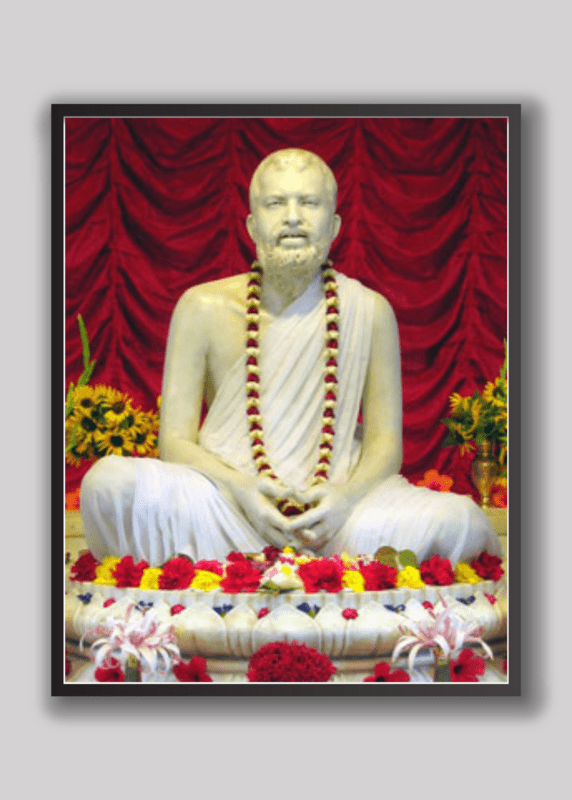
If a marble image can make you get that kind of devotion, why does the ‘movable image’ like you and me [not] have the same thought? You can have the same thought, same attitude. You should be a little bit more [receptive or responsive?] to a human being, because there [the marble image] it does not react. Here, it reacts, therefore you’ll be extra careful. You’ll have to be? Extra careful.
When fire is hidden in stone, you’re not so careful. But let fire manifest in the form of flames in the grass, you’ll become especially careful. You’ll start seeing [checking] that it doesn’t run into another man’s land. So you watch how your feelings affect other people. That’s how you become selfless. By bringing higher and higher feeling [sensitivity] onto others.
Master [Sri Ramakrishna] brings it out very wonderfully in the life of one of the devotees. The devotee said she cannot think about God. That she cannot meditate. He was surprised that at such an old age she cannot [do that]. He said, ‘But why not?’ By all means he tried, but no, she cannot meditate. He said, ‘Do you love anything in this world?’ She said, ‘I only love my little grandson.’ Master said, ‘Alright, whenever you do anything [for him] think that you’re doing it for Krishna. If you’re giving him a bath, you’re giving abhishekam [a sacred bath] to Krishna. When you’re feeding him, you’re feeding Krishna. When you’re speaking to him, you’re speaking to Krishna.’ When she came back after two or three years, she had [experienced] the vision of Krishna. Through that [approach].
Now that is the proof. That we can take our shrine-orientated attitude and orientate [apply it] it universally, in the world. You can! There’s no two ways about it. But we are too sensitive, [worrying about] what the people will think about us. How the people will react and rob us. Because we are [mentally] robbers, we think they’ll rob us. Try it and see it. If it doesn’t work out, then let’s learn some other lesson from it. That is the idea. Even with the husband and wife. You think [he/she] is a god or goddess, but it’s so difficult. It’s only good as long as it’s good. No sooner something goes wrong, that’s the time you can’t think. [Swamiji chuckling]
You know, God is very funny. He told you, ‘I am memory, and I am forgetfulness.’ And he says that ‘I am a gambler. A tactical gambler.’ In the [Bhagavad] Gita [Chapter 10 verse 36] he tells you that. It’s amazing, but you can’t see it. Because it doesn’t suit you. You want everything to suit you. You see, if God doesn’t suit you, then you put him in other people. That’s exactly what you do. You want him to suit your fitting size. Like [Swami] Vivekananda says, ‘We don’t have to fit Christ into the church, we should fit the church into Christ.’ We want God to fit our concept. We don’t want to fit our concept into God. Think about it. And thus you will find, that you’ll expand.
So bhajan and kirtan is beautiful. But Ramakrishna’s word and advice you must take. In just one or two lines he says, it must be taken with knowledge. Think who you’re thinking of. If you think Ram, Ram, Ram and think that the long [tall] fellow that you love is waiting outside, that kind is not nice. You’re saying Ram, Ram, Ram and thinking, ‘That rascal robbed me.’ You think, ‘My friend Ram is waiting outside. We’ll got to the bioscope [movie house]’. No! It’s not that kind of Ram that I’m talking about. We’re talking about Ram who is Sat-Chid-Ananda, who was the ruler of Ayodhya. And what is Ayodhya? It is God himself. So you must become the ruler. You say Shiva, Shiva, Shiva – think about the auspiciousness. Let there be auspiciousness in the whole world.
Don’t bark [speak loudly] at anybody. If you want to get angry, get angry. But get angry like Shiva. Get angry with all adharmas [unrighteousness]. But the adharma that is inside you, you’re not getting angry with it. You want to get angry with outside adharmas. Ramakrishna said, ‘Get angry by all means, but get angry with yourself that you’re not realising God. Or get angry with God: ‘Why are you not revealing yourself to me?’ That’ll be a better way. The idea there is that you always get angry with a weak person. If someone is superior to you, you never get angry with them. Because they or your boss can give you one nice one [a slap!] Someone does that a couple of times and you’re, ‘Yes, sir, yes sir.’ [Of course in modern labour relations terms, this would not happen today, but we get the idea.😂] Sometimes he’ll bark at you and he’ll fire you and you’ll talk ill of him, but you’ll think about how you lost the work.
So, the idea is that weakness is anger. But if you really want to get angry, your anger will suit you if you get angry with God. With who? God. Ravana [the demon king] teaches us all that lesson. He was not angry with anybody else, but with [Lord] Rama himself – the supreme being. Even a foul method he used to get near him [Lord Rama]. Any method is OK, as long as you get to God. Not to man. Someone told me, ‘If I go and steal God’s wife, will I be alright?’ [Referring to Ravana abducting Mother Sita]. I said, ‘First, fool, find out where he [God] lives, then think afterwards, what to do. But find out first where he lives.’
But Ravana was great, He was a pandit [learned scriptural scholar]. He knew where he [God] ‘lives’ and he went and grabbed hold of the right place. Sita was bhakti [divine love and devotion]. He [Ravana] stole bhakti away. [inaudible few sentences…] Where love is, there the heart must be. Rama’s body was in India, but his heart was in Lanka. Think about it. [Takeout thought: And that’s really what Ravana went to ‘steal’? – God’s heart.]
The free-to-read, 396 page Flipbook version of Swamiji’s biography is available by clicking HERE.
These recordings were made from the 1970s onward, by Mother Radha, a close devotee of Swamiji’s and edited for uploading here by our gurubhai and her son, Brother Tim. Please be mindful that what Swamiji was saying may have been specific to an individual or a group of people with him, at the time.