Talk Excerpts 486 & 487 combined. Swamiji touches on Shankaracharya’s Advaita Vedanta and Ramanuja’s Vishishtadvaita [qualified non-dualism].
From Mother Radha’s recordings of Swamiji.
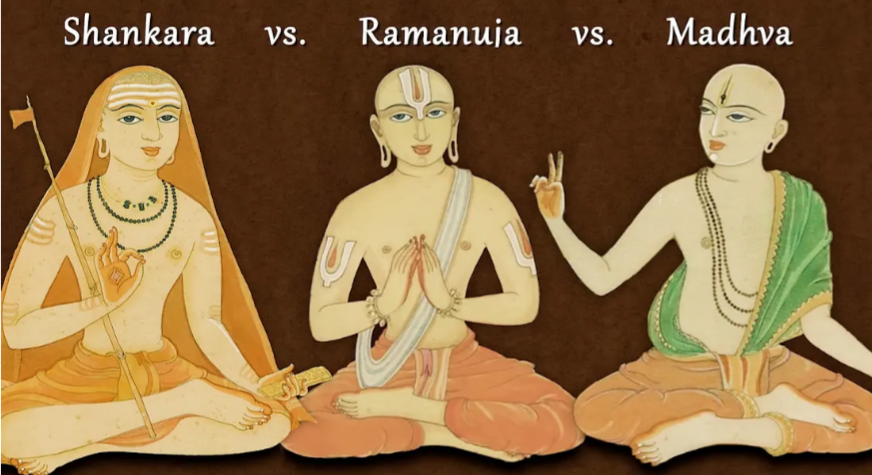
[Adi Shankaracharya – was ‘Father’ of Advaita Vedanta (non-dualism or ‘monism’) and Ramanuja was propounder of Vishishtadvaita (qualified non-dualism) philosophy.
First is the quality, but the quality and the possessor of the quality become One. Ultimately you will find they are not two.
You may say God is happy but you cannot say He is sad – He has no sadness in Him.
Ramanuja went on to say that, like the pomegranate, it is one fruit but still there is separation in it. There are many seeds – but one fruit. You cannot take away one seed and still say it is a pomegranate.
Take a piece of cloth. If you pull the threads out, where is the cloth? Similarly the body and mind, the world and God, are interwoven. One depends on the other.
The soul depends on the Eternal Lord. They are inter-dependent.
Shankaracharya said: ‘A drop of water falling in the ocean becomes one with the ocean.’ Later on, when you reach that level, you will find out why Shankaracharya shows us (through his reasoning) that: Though there is unity and yet individuality, in reality this individuality has become One, has become Brahman.
Shankaracharya’s philosophy is the highest. The saint, in his realisation of oneness with God, says, ‘I have found that One from which we have all come and from which even this world has been projected.’ That is the Absolute, the highest.
Ramanuja said, ‘Whilst we are dependent on different or individual bodies, we are parts of God and yet we do not become one with Him.’ That too can be contradicted through different arguments – but we do not have to go through that here.
People say, ‘I want to live in Vaikuntha.’ But I never want to go there. Even if Sri Krishna appeared and said, ‘Come here (to Vaikuntha) my child,’ I would say, ‘No thank you, my Lord. Who knows when you may throw me out.’ [laughter].
Where is God? That is the question that must be asked. You may say, ‘God is in heaven.’ Then I must ask, ‘Who made Heaven?’ You will say, ‘God.’ ‘Who made Earth?’ ‘God.’ ‘Who made Hell?’ ‘God.’ Then I must ask, ‘But before making Heaven where was He? You do not know. You cannot answer. Shankaracharya said, ‘Higher than that, is Brahman, without qualities, without name, without form.’
Devotee: But didn’t Ramanuja say, ‘Vaikuntha is eternal’? Swamiji: That is what he said. But what does he know about Eternal? If God can throw a man out from there then I am afraid to go there. I will never go there. Ultimately, when dissolution comes, even Vaikuntha will be dissolved. I do not say what Ramanuja said is wrong. It is a stepping stone to higher things, as Swami Vivekananda said.
Even if Gurudev [Swamiji’s beloved Guru, Swami Nischalananda Puri] said, ‘Come here, here is guruloka,’ I would say, ‘Thank you, Gurudev, I do not want it.’ Loka means change, and I have had enough of these changeable things here.
[Although not raised by Swamiji in this talk but just so you have the 3 schools under one roof in this post for comparison purposes]: It was Madhvacharya who in the 13th-century, propounded Dvaita Vedanta – Dualism. It emphasizes the eternal and fundamental distinction between the individual soul (Atman) and the Supreme Being (Brahman), identified as Lord Vishnu).
The free-to-read or download, 396-page Flipbook version of Swamiji’s biography is available by clicking HERE. If you’d prefer the PDF version, please click HERE.
These recordings or the excerpts from them, were made from the early 1970s onward, by Mother Radha, a close devotee of Swamiji’s and edited for uploading here by our gurubhai and her son, Brother Tim. Please be mindful that what Swamiji was saying may have been specific to an individual or a group of people with him, at the time.