Talk Excerpts 757 to 760 combined. The renunciates ask Swamiji questions.
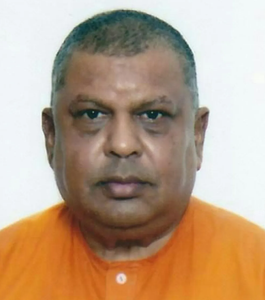
From Mother Radha’s recordings of Swamiji.
Excerpt 757:
Pravrajika Atmaprana: Would Swamiji say that it is sat chit, or Satchidananda together?
Swamiji: Satchidananda is only One. It is different aspects of that One.
The dispelling power of darkness is in the lamp. When the light comes on, what happens? The darkness goes.
Sat is existence. Then side by side it has knowledge – which makes me see a thing in its rightful place. And because of that I feel happy – ananda – there is no confusion there. So all three are in One. Sat is not different from chit and chit is not different from ananda. The whole three are only One – Satchidananda, meaning Existence, Knowledge, Bliss Absolute.
Ultimately Satchidananda is only the limited reading the Unlimited. You can’t give a description to that which is inexplicable. The most one can say about the ‘Absolute’ is that there is nothing beyond That. Hence it is inexplicable.
The question people will put to you is, ‘Didn’t Sri [Adi] Shankaracharya limit the Unlimited by saying Satchidananda?’ My answer would be: He is guiding us forward by hinting about the nature of the Supreme Reality. That which is beyond description is unlimited, yet we have to [attempt to] describe it to know Its nature. The limited mind uses these descriptions to progress. One who is God-realised knows that it is infinite and beyond limitation.
When I say it is sat it means it is existence, not non-existence. So it removes non-existence. Ultimately that which I know as existence must go too, because the Absolute cannot be thought of.
Excerpt 758:
. . . Then he said chit – Consciousness. So it removes that which is not conscious. If I say ‘chit’, I mean consciousness. Consciousness removes that which is the opposite of consciousness. What I know as consciousness in my limited sense must also go.
Ananda will remove misery, sadness and pain. Once that is removed, then what I know as ‘ananda,’ must go too. Then I am That. So that is why it is necessary to add the word ‘absolute’ at the end of Satchidananda. When we say Satchidananda, we have to emphasise that it is Satchidananda Absolute.This is how the Upanishads describe it.
Then what relationship does the Absolute have with this apparent relative existence? I say ‘apparent’ because Vedantists believe that everything is only an appearance. Example: the desert and the mirage. What existence has the mirage with the desert? It is apparent, not real.
Atmaprana: But the Consciousness that is in everything – are the forms only apparent? Swamiji: Yes, because forms change while Consciousness remains the same. As Sri Shankaracharya explains: If only THAT exists, then where is the relationship? With what or with whom can there be a relationship since only THAT exists? We have to realise this within ourselves first, then we can see it everywhere.
Excerpt 759:
Atmaprana: If you are looking at Consciousness in everything, at that particular moment you are actually going beyond the form of the thing . . .
Swamiji: But then there is one small thing you are forgetting: it will not be you looking. It is Consciousness looking at Consciousness. Remember this.
Mantras are never forgotten. Theories are forgotten.
Swami Saradaprabhananda [3rd President of the Ramakrishna Centre of SA and current President of the Ramakrishna Centre of SA, Phoenix, in Durban]: A question a few children asked at the recent Yoga Camp was, ‘Who was Lord Shiva’s father?’ How are we going to answer that to children?
Swamiji: You must ask them, ‘Do you think Lord Shiva is God?’ If they say no, then you say, ‘You are wrong, Lord Shiva is God. God is one. He takes many forms and one of the forms is Lord Shiva. And God has got no father.’ When you are talking about human beings, then human beings have a father. Lord Shiva is the father of all and He does not need a father because He is God.
When a question is asked, think whether it is a spiritual question or a worldly one. When you point out to the child that it is God you are talking about, not man, then they will understand.
Excerpt 760:
[Advice to the renunciate devotees]:
What I say must give you knowledge, then it is good; it mustn’t thrill you. When someone tells you something, it thrills your mind and you smile. There’s a big difference.
Sri Ramakrishna has a divine smile. Every picture of him has a smile. But can you see it? You have to be so observant. That is a ‘knowledge [jnana] smile’. That is called ‘a blissful smile’. Others are smiling – that is called ‘sensual smile’. The smile of a saint makes us sattvic.
Sri Krishna Bhagavan says in the Bhagavad Gita that the ignorant think that he takes birth. In reality he never takes birth, nor does he die. All Incarnations [avatars] never take birth; because their birth is not through human parents, like ordinary human beings. Even when Sri Ramakrishna was born, his father was in Gaya, Master’s conception took place in Kamarpukur, from the light of the Shiva Lingam.
The avatars know that they themselves willed it. They take on a body to help humankind. They know that they are beyond the limitations of a body.
You control your nature, and God will fulfil your desire.
If your curiosity is working, know something is wrong – it agitates the ego.
Never take me for granted and you will be all right. Never assume I will give you 1, 2, 3 chances.
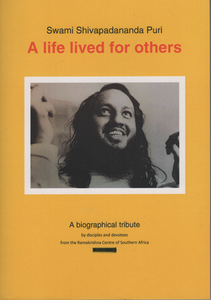
The free-to-read or download, 396-page Flipbook version of Swamiji’s biography, ‘A Life Lived For Others‘, is available by clicking HERE. If you’d prefer the PDF version, please click HERE.
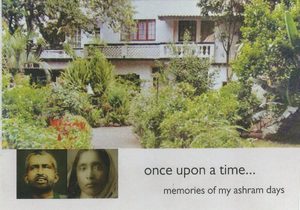
For our gurubhai Atmaprakash Kramer’s beautiful pictorial ‘memoir’ booklet of the Ramakrishna Centre of South Africa, Avoca Ashram, please click HERE.
There’s also a Facebook site for Swamiji’s posts now. They’re for newer readings published much more recently. Click HERE to view.
These recordings or the excerpts from them, were made from the early 1970s onward, by Mother Radha, a close devotee of Swamiji’s and edited for uploading here by our gurubhai and her son, Brother Tim. Please be mindful that what Swamiji was saying may have been specific to those with him at the time.