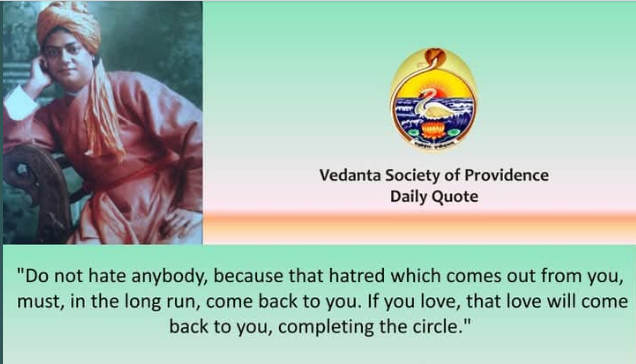
Talks Excerpt 438. Swamiji says: If you hate someone, this makes – and leaves – on them and you, a [negative] mental impression.
From Mother Radha’s notes, written at Swamiji’s feet.
[During an Upanishad class]: To be gods you must have good tendencies – i.e. you must do good and leave out the bad – otherwise you are an asura. Which do you want to become?
Try to do good to the devotees and help them.
When your merit and demerit are equal, you are a human being. The most sublime good is to become divine – then you become God, and you know everything.
Now you only know it as it appears to be.
May He help us to reach His lotus feet – to be good – to be Ishwara and beyond that: Parabrahman.
May the Eternal fire take me, may I take eternal rest and not take birth again. Divinity is my real nature. You can find this in the scriptures.
When you recite mantras, other than the guru mantra, do not mutter them, but repeat them loudly.
Om is not Brahman, but it indicates Brahman.
Sri Ramakrishna says: If you see an imitation apple, it reminds you of a real apple. Similarly, when we see the murti [sculpture, painting, picture or other representation], it reminds us of the Deity.
An illusion – or ignorance – is when you see a rope and you think it is a snake. This leads to fear, sweating. [This is the metaphor used in Advaita Vedanta for explaining Maya – which Swamiji stressed again and again does not mean something’s totally false, unreal etc. but rather that it’s only partial truth.]
If you hate someone, this makes – and leaves – [on them and you] a mental impression. If you keep thinking of love, you replace the feeling of hate with the feeling of love.
The free-to-read or download, 396-page Flipbook version of Swamiji’s biography is available by clicking HERE. If you’d prefer the PDF version, please click HERE.
These recordings or the excerpts from them, were made from the early 1970s onward, by Mother Radha, a close devotee of Swamiji’s and edited for uploading here by our gurubhai and her son, Brother Tim. Please be mindful that what Swamiji was saying may have been specific to an individual or a group of people with him, at the time.