Talks Excerpt 446. Swamiji explains the origin of the Ramakrishna Centre of SA ‘Yoga Camps’ or ‘Retreats’.
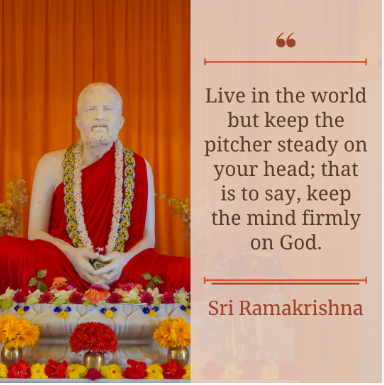
From Mother Radha’s recordings of Swamiji.
To do your sadhana the scriptures say you have to get up at sunrise, nay, before sunrise. You can only get up before sunrise if you go to bed early, so please try to do this.
Gurudev [Swamiji’s beloved guru, Swami Nischalananda Puri, and our revered ‘Gurudev’] got the idea to have these Yoga Camps/Retreats from the Gospel where Sri Ramakrishna explained to Swami Vivekananda, that time is too short in this life, days are shorter still. There is no time for anyone, they are all busy winning bread (making money). But once or twice a year if they take three, four or twelve days off and do sadhana sincerely, if they cry for God for three days and three nights sincerely, God must reveal Himself to them.
Our sadhana is based on this. We know that Master’s words are mantras, and what he has said will not fail. [The Hindu scriptures say that every word spoken by a God-realised person is a ‘maha vakya‘ – an eternal great truth.]
Remember that of these garlands of flowers I put on you, some have thorns and some have only roses.
God can take whatever form you like. If you think of God as Lord Shiva, He’ll take form as Lord Shiva. If you think of God as Ravana, He will come as Ravana.
The Bhagavad Gita says, ‘Lust, anger and greed are the gateways to hell.’ Ravana had all these ruling him. Sri Rama did not have any of these ruling him – he was beyond lust, anger and greed. He had all his senses under control. Sri Rama stands for disciplined human beings, and Ravana stands for non-disciplined human beings.
The free-to-read or download, 396-page Flipbook version of Swamiji’s biography is available by clicking HERE. If you’d prefer the PDF version, please click HERE.
These recordings or the excerpts from them, were made from the early 1970s onward, by Mother Radha, a close devotee of Swamiji’s and edited for uploading here by our gurubhai and her son, Brother Tim. Please be mindful that what Swamiji was saying may have been specific to an individual or a group of people with him, at the time.