Talks Excerpt 484. Swamiji says you’ll get what you pray for.
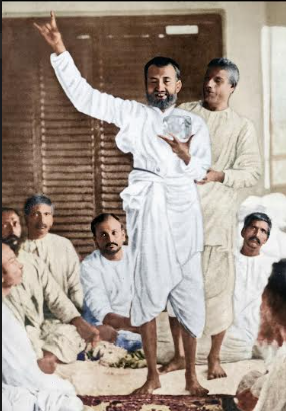
From Mother Radha’s recordings of Swamiji.
[From ‘Days in an Indian Monastery‘ by Sister Devamata]
When materials were lacking for the building of this [meditation kutir], Sri Ramakrishna prayed to his Divine Mother, (Swamiji: notice that he did not ask man), and as the flood tide [on the river Ganga] receded, it laid on the river bank a bundle of poles with strong cord and a sharp knife. His prayers were never fruitless.
Swamiji: Mother Ganga took it from somebody and brought it and left it there. If you want something, pray, and it must come. I am convinced of this. If your prayer is sincere it must come – the Master is my witness. Whatever you wish for will come. But if you wish for chillies, you will get them, and you know how they burn? If you wish for ice-cream you know what a taste you get? So you can wish for whatever you like, but be careful.
A Temple cow chanced to go astray that same day and the gardener searched for it without avail. Toward the evening however, when it was time for milking, he plunged into the jungle near the garden wall and there, under the Bel tree, sat Sri Ramakrishna in deep meditation. He had been meditating the whole day. The lost cow too was not far away.
Swamiji: It looks like Mother sent the cow there to find out where Sri Ramakrishna was. Similarly, dharma must be followed to reach the goal.
At one time Mathur Babu [son-in-law of the Rani Rashmoni – who built the Kali Temple at Dakshineswar. And who Sri Ramakrishna said was one of the eight attendants of Mother Kali Herself, who came to earth for that purpose] asked the Master, ‘Can God make a bush that produces only red flowers, bear white ones?’ ‘God can,’ Master answered. Mathur did not believe him. But the following day Master saw, in the garden, a hibiscus bush covered with deep red blossoms. There was just one stalk on which, beside the red flower, was a snowy white one. Master picked both on the stem and showed them to Mathur. Then he laughed.
Swamiji: You see, it did not make any sense to Mathur. He thought it must be a freak of nature.
Once, Mathur laid at Master’s feet a very beautiful shawl. Sri Ramakrishna took delight in its beauty and wrapped it around himself. But when Hriday [Master’s nephew] reminded his uncle that much had been paid for the shawl and that he should take good care of it, wearing it only on important occasions, Sri Ramakrishna replied, ‘Shall I let this miserable shawl take my mind from God?’ Then he held a corner of it in the fire. ‘Now it is burned and has no value,’ he exclaimed with satisfied content, ‘I can wear it in peace without fear of greed or pride.’
Swamiji: When we read like this, take the text and contrast it with your mind – how your mind would have acted under those circumstances and in that environment. Hriday himself was conscious about how costly it was, but Sri Ramakrishna was not.
There was another time when somebody gave him something. He took it at night and left it near the dustbin. Someone asked him why he had done that. He said, ‘Someone who needs it will take it and go away.’
This is the Deity that you are worshipping. A Deity without any outer show but with inner realisation. A Deity that saw into the minds and hearts of others. A Deity that did not know what he was doing for twelve long years because he was absorbed by God and God thought. A Deity who did not know when he stopped breathing and had to be reminded. Now this may sound like fiction but it is true.
This was written by Devamata and I am reading it to you because she decided to reveal certain secrets.
The free-to-read or download, 396-page Flipbook version of Swamiji’s biography is available by clicking HERE. If you’d prefer the PDF version, please click HERE.
These recordings or the excerpts from them, were made from the early 1970s onward, by Mother Radha, a close devotee of Swamiji’s and edited for uploading here by our gurubhai and her son, Brother Tim. Please be mindful that what Swamiji was saying may have been specific to an individual or a group of people with him, at the time.