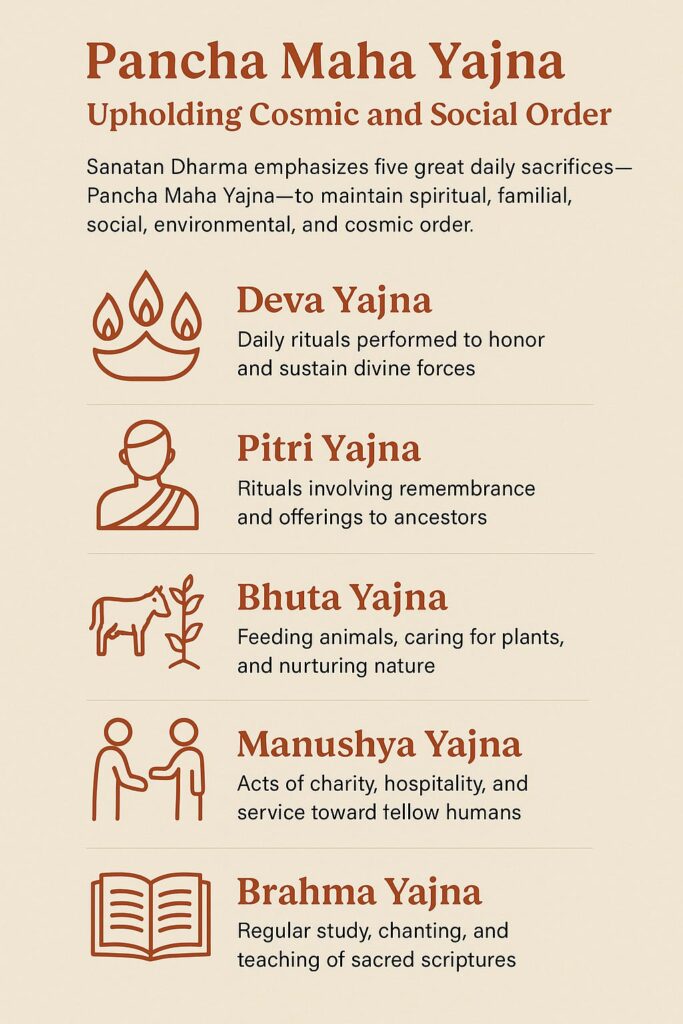
Talks Excerpt 489. Swamiji elaborates on the 5 Maha Yajnas.
From Mother Radha’s recordings of Swamiji.
[The Pancha maha yajnas continued. For post 488 on the topic, click HERE].
These five great Yajnas give us a certain moral character and should not be neglected by householders.
Let us take the first one: Deva Yajna – worship of gods or deities. Or, if you are a Vedantist in the non-dualistic sense, it is the worship of God. So no householder is excluded from worshipping God or God’s manifestations as deities.
The next one is called Rishi Yajna. Now Rishi Yajna is the study of all the scriptures, of all the dharmas – in particular of your own dharma, your own religion. The householders may be observing the first Maha Yajna but the second one is the important one. You must be serious because without real thought we become immature beings. Your children too should be taught this.
Imagine that you are waiting for your husband to come home after preparing some wonderful dishes for him, and when he comes in, he says, ‘No thanks, I won’t eat, I have just had something at the hotel.’ Think what happens to the feeling of love, the feeling of devotion in your heart. It is shattered. Similarly, if we do not study the scriptures, which were given to us through great sacrifice, then we are treating the Rishis exactly as that husband is treating his wife.
The third one is the Pitra Yajna. That is: service of your mother and father – physical service. When they are not in the body any longer you pray to God for their salvation and you pray to them to bless you. Above all, when they have departed, you keep your conduct so pure that their good name is preserved.
The fourth one is Atithi Yajna. This is made up of service to the poor, to the needy and to the community. In the olden days in India people made homes for the poor, they also dug wells for them so they could then drink, wash and make offerings of water to God, to Surya Bhagavan, to pitras, and to the Rishis. There are many examples in the Hindu religion where someone first went out looking for poor people to feed and only then partook of their own food. They treated the poor as veritable embodiments of the gods.
It is said that when a guest comes to your house if you do not at least offer him water and a seat, you are cursed. In Hinduism it is not that a guest has come home but rather that God has come home. Please do not treat this lightly.
Charity was not only done by building houses and digging wells. It was also done by giving knowledge, or physical labour, or if they had money, they gave money, if they had clothing, they gave clothing. They did not keep more than they needed, otherwise they transgressed another rule from the scriptures: Do not be greedy.
The fifth and last one is Bhuta Yajna. Some people think this is worship of departed spirits. No. One of the things it deals with, is land. What you take out of the land you must put back into the land. For example: Rotation of crops. The trees and the plants should be watered and the animals, birds, and insects should be protected.
Nowadays you have the SPCA, but this type of thought was started thousands of years ago.
The free-to-read or download, 396-page Flipbook version of Swamiji’s biography is available by clicking HERE. If you’d prefer the PDF version, please click HERE.
These recordings or the excerpts from them, were made from the early 1970s onward, by Mother Radha, a close devotee of Swamiji’s and edited for uploading here by our gurubhai and her son, Brother Tim. Please be mindful that what Swamiji was saying may have been specific to an individual or a group of people with him, at the time.