Swamiji speaks about the vows of sadhana, poverty and brahmacharya.
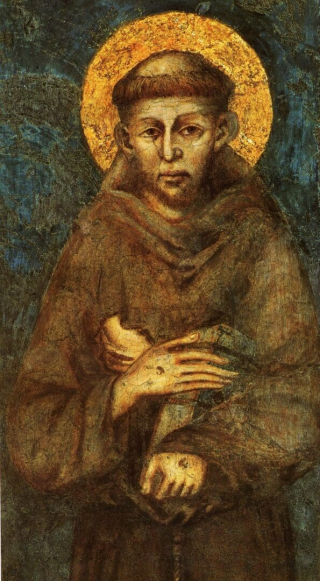
This portrait of St. Francis of Assisi was painted by Cimabue – an artist, friend and disciple of St Francis'. It's nothing physically like the star of Director Franco Zeffirelli's 'Brother Sun Sister Moon' movie idealisation of the saint's physical appearance Or the romanticised versions of him as a delicate sadhu. But this is undoubtedly more accurate and real.
Swamiji said to me, of this perfect example of poverty, chastity and obedience in Christian monasticism, 'St. Francis came to show us the negative path.' The saint's emphasis [clearly needed at the time] was on unworthiness, sinfulness and contempt/deprivation for the body. This whilst having only divine love for God, and serving the poor, sick and needy.]
Sri Ramakrishna and Swami Vivekananda incarnated with a new message for a new era, that 'Each soul is potentially divine' and that we can return to that awareness through the right disciplines and grace.
[After all of that,😉] This is a very brief audio clip – but on a hugely important topic.
Swamiji, although there were clearly also householders present, is almost certainly focusing on the monks and nuns from the ashram. He's quoting his Guru [our Paramguru], Swami Nischalananda Puri, the first President and Spiritual Head of the Ramakrishna Centre in South Africa.
Gurudev [as we refer to him] says Swamiji, was emphatic about the three things necessary for monastics or deeply serious sadhakas, to live a life of credible and sincere spirituality. They are: Sadhana, Poverty, Brahmacharya. [Christian monks and nuns take vows of Poverty, Chastity and Obedience, the latter being their term for sadhana or prayer and service.]
Swamiji emphasises that sadhana or meditation doesn't mean sitting in a cave or corner somewhere, whilst meditating, but rather constantly remembering God as one serves all of consciousness, and goes about one's daily responsibilities – including family and household duties.
The second aspect is poverty. Swamiji says the only thing we leave this life with, is our love for God – which is God's love anyhow – and it's for us to give it back to God. Nothing else.
Listen to what Swamiji says about 'ownership', real or imagined, of any sort. So this is definitely not a message to householders in their respected, necessary and praiseworthy grihasta ashram [married] estate. [As I've mentioned before, Swamiji once said to me, 'This time I have come for the householders.' So this is not, and never will be, a 'superiority' of status or role, contest.]
[Site admin: Monastic poverty is something very special. At the Nirmal Hriday Home for the Dying in Kolkota, Mother – now Saint – Teresa's Missionaries of Charity nuns have just two saris and one large galvanised bucket as their so-called 'possessions'. That bucket is used to wash the sick and dying, themselves, their saris and it's used for swabbing down floors and for any other cleaning tasks. The nuns don't ever 'own' them.
In the life of St. Francis of Assisi, he had to be bound by a specific instruction of obedience, issued by his brother monks. They told him that his monastic habit, albeit made of rough, undyed, grey sack-cloth (not the brown you see today) did not belong to him. And therefore he was not allowed to give it away to anyone – or that's exactly what he had done, and would continue to do, for the poor.]
Swamiji repeats: First was Sadhana, then Poverty. Now Swamiji addresses Brahmacharya. Commonly thought of only as control of sexuality or continence. But once, in our early ashram days, when Swamiji was talking to us about sense-control in the broadest sense, he asked me, 'What is Brahmacharya?' My answer was 'continence' – meaning restraint from sexual thought, word or deed in the secular sense. Swamiji immediately said 'That's because of where your thinking is right now.' He went on to say, 'Brahmacharya, to me, is if I forget my Lord for even one second.' What an inspirational and amazing definition.
The second part of this short audio clip is Swamiji explaining why he's gradually 'withdrawing' and why he has initiated monastic disciples. As the saying goes, 'Action speaks louder than words.' This is the rationale of a true renunciate.
Swamiji wraps up the homily with a delightful little joke about the choice between being a chela and a Guru.
To listen to these powerful thoughts, please click on the link below. Jai Sri Ramakrishna!
Duration: 02:50
The original audio recordings of these posts were made by close Ramakrishna Centre of South Africa and Swami Shivapadananda devotee, Mother Radha. The audio editing and noise reduction of the original 1970s-onwards tapes, has been lovingly engineered, over many years, by her son and our dear gurubhai, Brother Tim. May Sri Ramakrishna and Swamiji bless them both.
Admin tip: Underlined words are links. If you click on them, they'll take you to an explanation of the particular word or term. [In these overviews, Admin comments are typically in a smaller green font, and square bracketed, like this statement.]
Dear reader, if you spot typos or or other errors, please feel free to email the site admin on info@imbizo.com with your suggested correction/s.
Context: As always, care should be taken to remember that what Swamiji was saying, may have been very specific to the needs of people with him at the time. Please bear this in mind.
Links to our Guruparampara (spiritual lineage) organisations, which will broaden your knowledge base: Ramakrishna Math and Mission and our alma maters, the Ramakrishna Centre of South Africa and the Sri Sarada Devi Ashram in Durban. The Ramakrishna Centre of Johannesburg is also active in Gauteng province in South Africa.
There are various publications [The Gospel of Sri Ramakrishna etc.] which you can download at no charge, from the Ramakrishna Centre of SA website page, HERE.