Swamiji on knowing your past, doing sadhana and loving God.
Swamiji concludes a reading about the importance, in our dark or down moments, of remembering the great ones who have gone before us.
Swamiji quotes Swami Vivekananda as saying we should know seven generations of our own mortal family. He says that perhaps our father was a drunkard [mine was] and therefore won't be an inspiration. But that we can take inspiration from the fact that we avoided falling into the same pattern.
If we know our Guru Parampara [spiritual lineage] it will inspire us to such an extent, that we will want to reach those same levels of enlightenment.
Swamiji goes on to explain that only as a human being do we have the faculty of discrimination [viveka] – so only as a human being, can we realise the highest levels of spirituality, or reduce ourselves to the lowest.
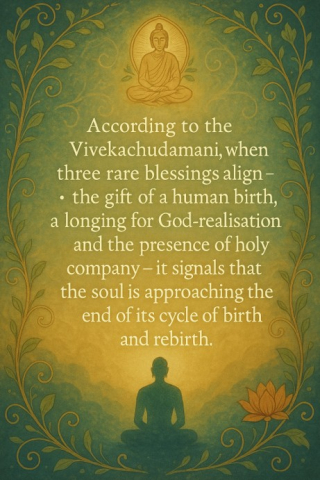
As Swamiji says, even gods and angels have to take a human birth again, before obtaining moksha [liberation from the cycle of birth and rebirth]. A human birth is a rare privilege. Take note of the visual in this post, paraphrasing an excerpt from the Vivekachudamani.
Swamiji tells how Arjuna asked Lord Krishna what happens to the person who has a desire to become a yogi and realise God, but somehow fails. And the Lord answered that the person would take birth in another place, where conditions are more conducive to achieving that goal.
Swamiji explains the differences between kinds of desire. Helpful for those of us on a spiritual journey, who need to carefully discriminate between bad, good, and even beyond good. To realise God is a desire. But it's not a worldly, binding desire, says Swamiji.
Swamiji says that state of mind equates to state of health. Because if we're disturbed in mind, then our cellular vibrations will be disturbed, and because of that vibration, we'll suffer from different kinds of disease. Swamiji speaks about 'reciprocity' – in which the mind can make the body ill, but damage or injury to the body, will in turn, affect the mind. [A phenomenon known to the Rishis thousands of years ago, which is well recognised and used in psychiatry, mental health and traditional healing today. Psycho-somatic, meaning mind to body. And biofeedback – body to mind. It's also used extensively in sports psychology, to achieve optimum performance.
In a similar vein, Swamiji and I were one day discussing DNA and how it affects so many individual human characteristics. Swamiji confirmed that just as DNA determines so much of how we look, what we are and how we behave – our thoughts, actions and habits write back to that DNA – reprogramming it.]
Talking about mind-management, Swamiji stresses, as he so regularly does, that attending satsang is a great way to get inspiration and activate our spiritual life. But sitting at home each day and brooding away about lack of visitors and so on, will lead to a decline in mood and state of being. Go to where they speak about God, the greatness of holy people and so on, says Swamiji, and the mind will be positively influenced and activated.
Swamiji speaks of three different ways to inspire or activate people: One is fear. Swamiji gives examples of it. The second method is to provide incentives or suggest positive outcomes to their activity. The third method is the highest. Worshipping God without motive but simply because God is there to be worshipped. That person's nature will lead them to do so. Love for love's sake – that's the highest.
Swamiji wraps up the homily by telling the story of a Guru who sent his chelas [disciples] home with a piece of paper on which to write down the reason they loved and worshipped God. There's a beautiful conclusion to the story. Please hear it, from Swamiji himself.
To listen to this recording, please click on the link below. Jai Sri Ramakrishna!
Duration: 10:56
For a free-to-read, draft 394 page expanded version of 'A Life Lived For Others'.
Click here: → Swamiji's biography
You may need to install a PDF reader on your phone if that's where you'll be reading the book.
The original audio recordings of these posts were made by close Ramakrishna Centre of South Africa and Swami Shivapadananda devotee, Mother Radha. The audio editing and noise reduction of the original 1970s-onwards tapes, has been lovingly engineered, over many years, by her son and our dear gurubhai, Brother Tim. May Sri Ramakrishna and Swamiji bless them both.
Admin tip: Underlined words are links. If you click on them, they'll take you to an explanation of the particular word or term. [In these overviews, Admin comments are typically in a smaller green font, and square bracketed, like this statement.]
Dear reader, if you spot typos or or other errors, please feel free to email the site admin on info@imbizo.com with your suggested correction/s.
Context: As always, care should be taken to remember that what Swamiji was saying, may have been very specific to the needs of people with him at the time. Please bear this in mind.
Links to our Guruparampara (spiritual lineage) organisations, which will broaden your knowledge base: Ramakrishna Math and Mission and our alma maters, the Ramakrishna Centre of South Africa and the Sri Sarada Devi Ashram in Durban. The Ramakrishna Centre of Johannesburg is also active in Gauteng province in South Africa.
There are various publications [The Gospel of Sri Ramakrishna etc.] which you can download at no charge, from the Ramakrishna Centre of SA website page, HERE.
The visual in this post was generated using prompts to Microsoft Copilot Artificial Intelligence.