Swamiji speaks on the ONE God of Hinduism.
Swamiji is speaking somewhere, at an organised satsang [spiritual gathering or service]. And apologises for the limited time that he has to spend with the satsangis [attendees]. There are clearly a good number of children in attendance.
He gives a child-accessible lesson on the fact that Hindus worship only ONE God – but with many different forms and names. [Ekam sat vipra bahudha vadanti – 'Truth is One – sages call it by various names' – Rig Veda 1.164.46].
He uses the light being reflected from the glass on pictures of deities in the shrine or venue in which they're seated, to illustrate the point. It's only one light being reflected in all these different names and forms.
Swamiji uses ice as yet another analogy. How it can take so many different forms, but the substance, ice, is the same.
Swamiji asks for the names of the scriptures of various religions. The congregation respond but pause when it comes to the Hindu scriptures [because there appear to be several].
Swamiji explains that the Vedas are actually the Hindu scriptures. All other Hindu holy books derive their knowledge from the Vedas. If you say the [Bhagavad] Gita – the Gita preaches what is in the Vedas. The Ramayana preaches what is in the Vedas.
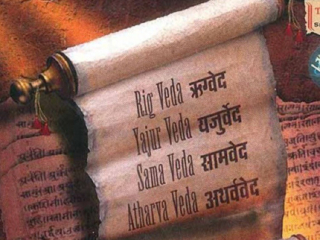
So the Hindu source-books are called the Vedas. Swamiji asks the congregation to name them, and says, there are four Vedas – the Rig Veda, Sama Veda, Atharva Veda, Yajur Veda. Swamiji reinforces that if asked about any of the Hindu holy books, they are all sourced from the four Vedas. Swamiji explains what secrets these great books, the Vedas, tell us.
He goes on to tell the children a story about a Pandit, wearing a pagri [turban], who asked God for lots of money, and was very disappointed at the small dakshina he received, following a ceremony over which he officiated. He was angry with God.
He decides to show up what he thinks are God's flaws or weaknesses. But before doing so, he needs a nap. He takes the turban off his bald head and dozes off. While he's sleeping Lord Vishnu says, 'Wait, I'll show this fellow!' The wind comes up, and he gets hit and hurt on the head by a falling mango. Then he realises that God's grace saved him from a very large fruit falling on and badly hurting him. So he and God are on good terms again.😉
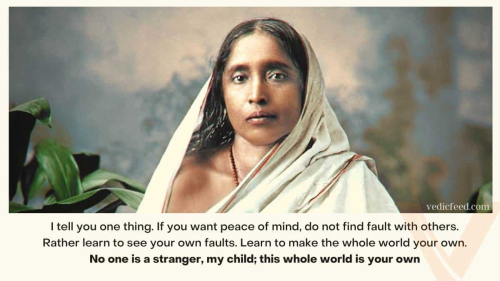
Swamiji wraps up the homily by quoting Holy Mother Sri Sarada Devi saying, 'I tell you one thing — if you want peace of mind, do not find fault with others. Rather, see your own faults. Learn to make the world your own. No one is a stranger, my child; the whole world is your own.'
Duration: 11:07
Click here for the Flipbook version of: → Swamiji's biography
It's a free-to-read, draft 396 page, extended version of 'A Life Lived For Others. No need to install a PDF reader. It'll work in your present browser.
However, if you'd prefer a straight-up PDF version, please click HERE.
Dear Devotee, if we use the term 'He or he', when referring to Swamiji, it's not impolite or disrespectful. It's to minimise the repetitiveness of saying or writing 'Swamiji' too many times.
The original audio recordings of these posts were made by close Ramakrishna Centre of South Africa and Swami Shivapadananda devotee, Mother Radha. The audio editing and noise reduction of the original 1970s-onwards tapes, has been lovingly engineered, over many years, by her son and our dear gurubhai, Brother Tim. May Sri Ramakrishna and Swamiji bless them both.
Admin tip: Underlined words are links. If you click on them, they'll take you to an explanation of the particular word or term. [In these overviews, Admin comments are typically in a smaller green font, and square bracketed, like this statement.]
Dear reader, if you spot typos or other errors, please feel free to email the site admin on info@imbizo.com with your suggested correction/s.
Context: As always, care should be taken to remember that what Swamiji was saying, was often very specific to the needs of people with him at the time. Please bear this in mind.
Links to our Guru Parampara (spiritual lineage) organisations, which will broaden your knowledge base: Ramakrishna Math and Mission and our alma maters, the Ramakrishna Centre of South Africa and the Sri Sarada Devi Ashram in Durban. The Ramakrishna Centre of Johannesburg is also active in Gauteng province in South Africa.
There are various publications [The Gospel of Sri Ramakrishna etc.] which you can download at no charge, from the Ramakrishna Centre of SA website page, HERE.
The image of the Vedas titles in today's post is borrowed from HERE.
The captioned picture of Holy Mother Sri Sarada Devi, is borrowed from HERE.