Swamiji speaks about Satyam, Shivam, Sundaram as life goals.
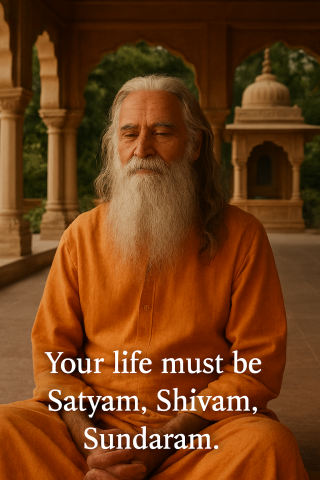
Says Swamiji: Animals have no moral principles as such. Because they are led by instinct. Man has got moral principles and he tries to formulate his principles to the highest code of the moral and ethical. If you want to be a real human being and not animal, then all the vows which you have taken, those are your principles. And you must as far as possible – as far as humanly possible, you must try and keep to it. And that is the only way we can say you are a man.
If you hear that the neighbour is behaving badly, then straight away we say [something like] look, he's got no principle. He's behaving like an animal.
Swamiji jokingly says that God, after making four-legged animals, made some two-legged ones. After the two legs there's no legs. It's evolution you see. So if you're evolved here, you keep to those principles. Just remember this. Don't worry about the world, but you must do what is right. Your life must be satyam, shivam, sundaram [Truth, auspiciousness, beauty]. May your life be full of truthfulness – satyam, may your life be always full of shivam, auspiciousness, may your your life be full of beauty – sundaram.
The ordinary man says, 'But I must have a life!' Where the ordinary man clings onto life, the sannyasi renounces life itself. What is there but to live for God and God alone? Aham Brahmasmi (अहं ब्रह्मास्मि)- I am Brahman. Tat tvam asi – that thou art.
The same practise is given in the Devi Mahatmyam, Ya devi, sarvabhuteshu, shanti rupena sangsthita, is a line from the Devi Stuti mantra, which means, 'Oh Goddess, who resides in all beings as the symbol of peace.' [For a gentle YouTube chanting of the Devi Mahatmyam, click HERE.]
You are peace. You are in the form of peace. Swamiji continues chanting a sloka from the Devi Mahatmyam. Oh Devi, we are born in the five elements and space, I prostrate to thee, I prostate to thee, I prostrate to thee, again and again.
Swamiji tells the story about dear old Pandit Shukla who used to come to conduct the major ritual worships at the Avoca ashram. Sometimes in the midst of the maha yagnas, he'd gently start dozing off, mid-chanting. [We all loved him. A short, plump man, he wore a Rudraksha mala, the bead-size of which we'd never seen before. If he sat down, it spilled across his lap and even onto the floor. He used to joke with one of the brahmacharis at the ashram, saying, 'You need to find yourself a 'home secretary' – meaning a wife – which we all found very funny. But as it happens, that brahmachari did go off and find a home secretary. 😉 So the dear old Pandit clearly knew something we didn't.]
There's considerable and merry discussion about the Devi Mahatmyam. And Swamiji then goes on to talk about seeing the Deity in everyone including family, and importantly for married people, in the in-laws, and the impact this approach will have on day to day engagements with other people.
Swamiji draws the threads of the discussion together by saying that we must think about and always aim for the highest. Some of us are so undecided, so small in our minds that when we look at a good thing, we want to run that good thing down. And this is why we don't progress.
Says Swamiji, 'We don't say that you must become that good. But at least try to become that. Then you are building your own life, instead of taking a good thing and dragging it down to your level, and even lower than yourself.
To imbibe this wisdom, please click on the link below. Jai Sri Ramakrishna!
Duration: 08:22
Click here for the Flipbook version of: → Swamiji's biography
It's a free-to-read, draft 396 page, extended version of 'A Life Lived For Others.
However, if you'd prefer a straight-up PDF version, please click HERE. (Depending on the age of your device or the browser you use, you may need to download a a PDF reader.)
Dear Devotee, if we use the term 'He or he', when referring to Swamiji, it's not impolite or disrespectful. It's to minimise the repetitiveness of saying or writing 'Swamiji' too many times.
The original audio recordings of these posts were made by close Ramakrishna Centre of South Africa and Swami Shivapadananda devotee, Mother Radha. The audio editing and noise reduction of the original 1970s-onwards tapes, has been lovingly engineered, over many years, by her son and our dear gurubhai, Brother Tim. May Sri Ramakrishna and Swamiji bless them both.
Admin tip: Underlined or coloured words are links. If you click on them, they'll take you to an explanation of the particular word or term. [In these overviews, Admin comments are typically in a smaller green font, and square bracketed, like this statement.]
Dear reader, if you spot typos or other errors, please feel free to email the site admin on info@imbizo.com with your suggested correction/s.
Context: As always, care should be taken to remember that what Swamiji was saying, was often very specific to the needs of people with him at the time. Please bear this in mind.
Links to our Guru Parampara (spiritual lineage) organisations, which will broaden your knowledge base: Ramakrishna Math and Mission and our alma maters, the Ramakrishna Centre of South Africa and the Sri Sarada Devi Ashram in Durban. The Ramakrishna Centre of Johannesburg is also active in Gauteng province in South Africa.
There are various publications [The Gospel of Sri Ramakrishna etc.] which you can download at no charge, from the Ramakrishna Centre of SA website page, HERE.
The visual in today's post was crafted using prompts to Microsoft Copilot artificial intelligence – AI.