Swamiji speaks on several topics, but ‘guiding the mind to concentration’ is the dominant theme.
God's power is mysterious. It is so mysterious that it keeps man from knowing who he is.
But this power can become what transforms your [present] knowledge – avidya maya, if you follow ethical and moral laws which reach non-injury in thought, word and deed [ahimsa]. If it weren't for this occurrence, then God's lila [divine play] would have ended. So therefore the whole world is known as God's lila. God's divine play.
But in this divine play, one thing is bad. We don't know who we are, and we're getting scared. Instead of knowing who we are and acting [living with sincerity] the part that we're supposed to act [perform] we try to leave our part and act something else.
Your question is, 'How did He [God] come about?' One can not say how he came about, because it is the nature of God. Because it is one of the powers of God. Which is known as illusion [Maya]. Illusion here only means it's a mysterious power which can not be explained by words. By thought or words. It is beyond thought – nirvachan [that which cannot be explained]. And something that is beyond thought is already inaccessible.
When we are worshipping in the manner of bhakti, we are still meditating, because we are leaving the whole world and thinking about truth within God himself. But the attitude of sitting may be something else. The attitude of trying to concentrate on that particularly Deity is something else.
Because the unconscious mind can never get God. The conscious mind can get it. A man whose mind is not concentrated, can not get God – it must be concentrated – and concentration itself is meditating.
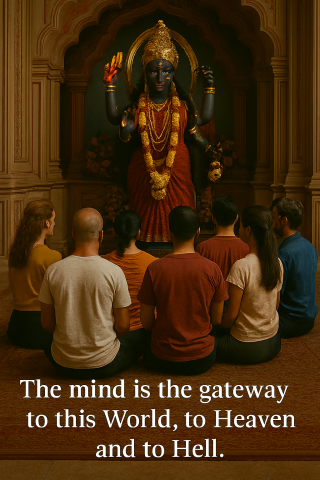
The mind is the gateway to God and the mind is the gateway to this world. The mind is the gateway to heaven, and the mind is the gateway to hell. So everything has to do with the mind.
Let's start karma yoga [the yoga of unattached work]. Let's start by way of ritual worship. You bring the wood and pile it up there for the hawan [ritual fire worship], getting the ghee [clarified butter], getting the camphor. Isn't it God? It's karma [in this case 'work'] that you're doing. So that karma has expanded service to man, and service to other people. And yet, concentrating on God then that karma also means concentration, which will end up in meditation. In which subject and object become one.
Sri Hanuman went to Lanka and he came to Mother. Mother came to know who he was and blessed him. But when they are talking about ashta siddhi, they are talking the knowledge of eight siddhis [powers]. And when the knowledge is given, the knowledge multiplies. You never get less.
Swamiji starts chanting from the Hanuman Chalisa. Says Swamiji: That was definitely given, because he [Hanumanji] had the essence of Ram. And Ram's essence being within, he had it, yet he was the servant of God. That's why the siddhi was given to him, so he could use it for God's purpose. Not for his own whims and fancies. Swamiji chanting from the Hanuman Chalisa again….
Janam, janam. Not once. Birth after birth he took Rama's difficulties away.
[Switching gears to the topic of 'destiny']: You can break up your destiny. Example: There's a cow, there's a long rope, tied to a peg in the ground. You have the free will to move from the peg to the length of the rope. Beyond that it is done. But if it so wills, it can what? Break through! What is binding you, is your past karmas that have created that apparent 'destiny'.
So by virtue of the fact that your past has created your present, so your present can also create your future. You can break up your 'destiny'. That's why in the Katha Upanishad, Yamaraja [the god of death] says to Nachiketa, that there are two paths. One leads to bondage and other to liberation.
Swamiji expands the theme to talk about two metaphoric paths to God. Millions of paths to the moon [chandra loka] says Swamiji, and yet just one difficult path with a few steps, like in a desert, leading to the sun [culminating in full illumination]. This has a parallel in shreyas [beneficial and long-term activity] and preyas [more enjoyment focused and short-term].
So if we choose the lunar path of satisfaction and reward, we'll keep going back and forth, in birth after birth. Says Swamiji, listen to me: symbolically, acha? [right?] Very few people take the path towards the sun. The first path, leading to the sun is called the good path. The second path, leading to the moon is called 'pleasurable' path. So if you seek pleasure, then you are seeking pleasure in the wrong place, or you are ignorant because you're not seeking pleasure in the eternal.
If you use a japa mala [prayer beads] all the time, and if your mind doesn't want to use it but it wants to still take God's name, it's a good idea. But if your mind wants to leave the japa mala, and take a walk and enjoy a pleasurable life, then it's a bad idea. A mala is only an aid to concentration.
Swamiji pulls the threads of the homily together, by giving examples of how different thoughts will distract from the japa [repetition of the sacred sound symbol, mantra of name of a Deity]. Swami refers to Gurudev [our param Guru] saying to him and others, 'At least you know the road to get here – [to the Ashram]. Swamiji said he used to wonder why. But now he knows – because you can guide others to the road. If someone needs directions – give it to them.
[Apologies for the progressively increasing background noise towards the end of this clip. But the gist of what Swamiji was saying, is there.]
If you'd like to hear these beautiful truths directly from Swamiji, please click on the link below. Jay Sri Ramakrishna!
Duration: 09:15
Click here for the Flipbook version of: → Swamiji's biography
It's a free-to-read, draft 396 page, extended version of 'A Life Lived For Others.
However, if you'd prefer a straight-up PDF version, please click HERE. (Depending on the age of your device or the browser you use, you may need to download a a PDF reader.)
Dear Devotee, if we use the term 'He or he', when referring to Swamiji, it's not impolite or disrespectful. It's to minimise the repetitiveness of saying or writing 'Swamiji' too many times.
The original audio recordings of these posts were made by close Ramakrishna Centre of South Africa and Swami Shivapadananda devotee, Mother Radha. The audio editing and noise reduction of the original 1970s-onwards tapes, has been lovingly engineered, over many years, by her son and our dear gurubhai, Brother Tim. May Sri Ramakrishna and Swamiji bless them both.
Admin tip: Underlined or coloured words are links. If you click on them, they'll take you to an explanation of the particular word or term. [In these overviews, Admin comments are typically in a smaller green font, and square bracketed, like this statement.]
Dear reader, if you spot typos or other errors, please feel free to email the site admin on info@imbizo.com with your suggested correction/s.
Context: As always, care should be taken to remember that what Swamiji was saying, was often very specific to the needs of people with him at the time. Please bear this in mind.
Links to our Guru Parampara (spiritual lineage) organisations, which will broaden your knowledge base: Ramakrishna Math and Mission and our alma maters, the Ramakrishna Centre of South Africa and the Sri Sarada Devi Ashram in Durban. The Ramakrishna Centre of Johannesburg is also active in Gauteng province in South Africa.
There are various publications [The Gospel of Sri Ramakrishna etc.] which you can download at no charge, from the Ramakrishna Centre of SA website page, HERE.
The visual in today's post was crafted using prompts to Microsoft Copilot artificial intelligence – AI.