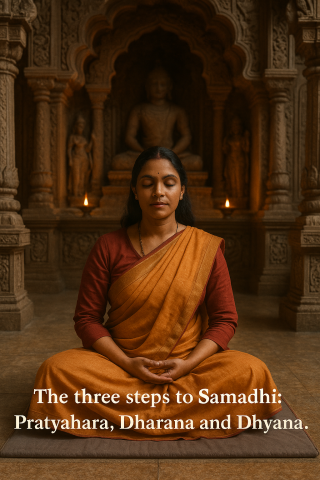
Swami explains Pratyahara, Dharana and Dhyana.
There's a variety of snippets at the beginning of this track. Swamiji explains the Maha Mritunjaya mantra meaning. He goes on to mention doubt as an obstacle but also an asset. Saying that if we doubt as in 'good' doubt; it means we're searching for something – so it's sincere and this is good. Doubt is not as bad as people make it to be.
Swamiji quotes one of the direct disciples of Sri Ramakrishna by the sound of it. Almost all of them were asked at different times, something along the lines of, 'Why are you still doing sadhana [spiritual practise] when you've experienced samadhi [superconsciousness] and are God-realised with Master's grace?' Their answers were consistently similar. 'We are making natural [repeatable] what Master gave us.'
Swamiji says that you may have a brief spiritual experience, but if you're not able to repeat it, its not yours. It might just have come at a particular time. But it's not yours until you can exercise it at will.
Pratyahara, Dharana, Dhyana. Pratyahara is playing games with the mind. It runs [outwards], bring it back. The mind runs out again. Bring it back. Again and again. Whilst, from the other other side, you have to practise yama [things we should do] and niyama [things we should not do] and asana [proper postural seating] – all of this, side by side.
Don't do over-limit pranayama [yogic breathing]. Over-limit pranayama, will heat your brain. Or it may happen that you get [mentally] weak, and do all the wrong things – or you start becoming too sensual. Take it easy, do it right. And side by side, carry on. But the most important I feel, is that purity, plus trying to gather the mind inside. And when you gather the mind inside, it [dharana] will be somewhere there – it won't go outside. But it will be somewhere there, dharana that is, and once you get that in place, you experience dhyana – proper meditation.
And if for fifteen minutes only you can keep it there, you must get samadhi [a superconscious state] here, now! Fifteen minutes only, you must get it. That is why emotionalism works in some cases.
Swamiji goes on to give examples of emotional arousal in action. But because the person was not prepared, he was not pure, the kundalini shakti [primordial energy located at the Muladhara chakra – tailbone region] concentration can not be held there. Because it's unprepared ground. With the warning at the end of it, that a very passive and receptive [unthinking] mindset can allow entry by a departed spirit. Hence the bizarre, hysterical behaviour that we often see in such manifestations.
If somebody asks me what is needed in spirituality, it's one-pointedness. One-pointedness only. Swamiji says this should be happening, but we're chasing after shadows.
He says that if we get the mind one-pointed, so many different powers will manifest. Then you must be 'shark enough' to eat up those concentration-delivered powers. Don't use them for psychic power purposes – siddhis. They say that to get the mind under control is a great strength. And when the powers manifest, to renounce those powers, what a great strength!
Swamiji says all of this is not some fancy or complicated scriptural process. It's plain and simple, and everyone can do it – the indrawing of the mind.
Swamiji says that Sri Ramakrishna gave us a secret, He said, 'When the mind is not pure, it is disordered [chaotic], and when the same mind becomes pure, it is Brahman.'
Wrapping up the discussion, Swamiji says: The same mind, when it is pure – no desires whatsoever – it becomes Brahman. He uses the analogy of fitting an arrow into the bowstring, pulling back [focusing] and releasing it to hit the target.
To follow these techniques, please click on the link below. Jai Sri Ramakrishna!
Duration: 07:01
Click here for the Flipbook version of: → Swamiji's biography
It's a free-to-read, draft 396 page, extended version of 'A Life Lived For Others.
However, if you'd prefer a straight-up PDF version, please click HERE. (Depending on the age of your device or the browser you use, you may need to download a a PDF reader.)
Dear Devotee, if we use the term 'He or he', when referring to Swamiji, it's not impolite or disrespectful. It's to minimise the repetitiveness of saying or writing 'Swamiji' too many times.
The original audio recordings of these posts were made by close Ramakrishna Centre of South Africa and Swami Shivapadananda devotee, Mother Radha. The audio editing and noise reduction of the original 1970s-onwards tapes, has been lovingly engineered, over many years, by her son and our dear gurubhai, Brother Tim. May Sri Ramakrishna and Swamiji bless them both.
Admin tip: Underlined or coloured words are links. If you click on them, they'll take you to an explanation of the particular word or term. [In these overviews, Admin comments are typically in a smaller green font, and square bracketed, like this statement.]
Dear reader, if you spot typos or other errors, please feel free to email the site admin on info@imbizo.com with your suggested correction/s.
Context: As always, care should be taken to remember that what Swamiji was saying, was often very specific to the needs of people with him at the time. Please bear this in mind.
Links to our Guru Parampara (spiritual lineage) organisations, which will broaden your knowledge base: Ramakrishna Math and Mission and our alma maters, the Ramakrishna Centre of South Africa and the Sri Sarada Devi Ashram in Durban. The Ramakrishna Centre of Johannesburg is also active in Gauteng province in South Africa.
There are various publications [The Gospel of Sri Ramakrishna etc.] which you can download at no charge, from the Ramakrishna Centre of SA website page, HERE.
The visual in today's post was crafted using prompts to Microsoft Copilot artificial intelligence – AI.