Daily Reading 118. Swamiji says don’t talk about any spiritual experiences you may have and gives very specific advice on mantras for sadhana.
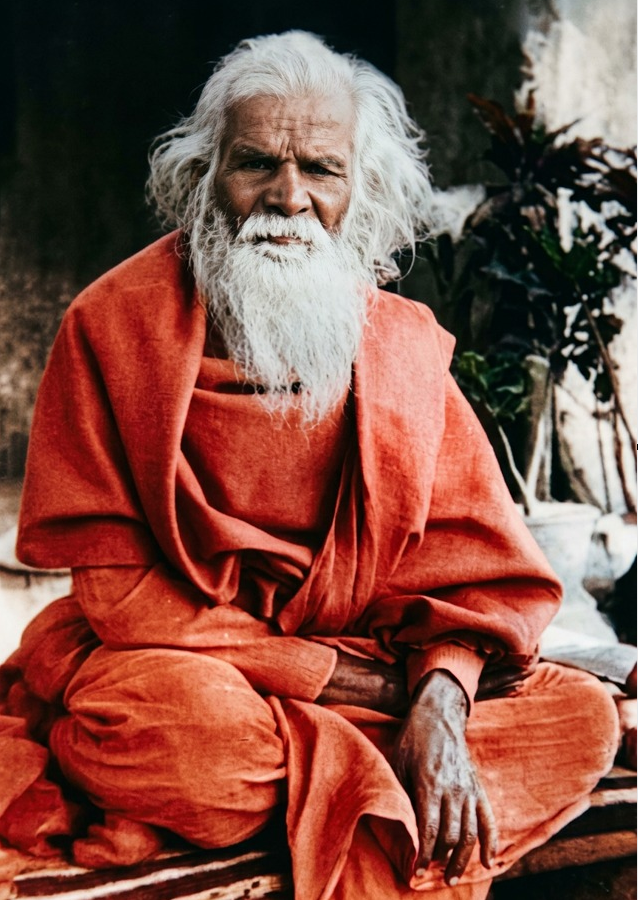
Taken from Mother Radha’s notes, written at Swamiji’s feet.
Do not discuss your spiritual experiences with anybody – including your wife. Not because they are secret but because if you have experiences and tell someone, they may not have had that experience. They will get a doubt and think, ‘But I have done so much sadhana [spiritual practice] . . .’ This leads to a bad relationship between the husband and wife and jealousy – and later to division – a block on the path.
There is no instant [God] realisation. Devotee: Someone [Narendra – later Swami Vivekananda] asked Master [Sri Ramakrishna], ‘Have you seen God?’ And Sri Ramakrishna said, ‘Yes, I see Him more clearly than I see you.’ What does ‘clearly’ mean here?
Swamiji: What we see is veiled [by Maya Swamiji said – we see ‘partial truth’]. When you see God it is One, when you see the world it is many.
When doing sadhana, first get the mind into a neutral position – for example concentrate on the Ishta [personal Deity]. If you have no Ishta Devata, then concentrate on something else. From there begins your sadhana. Do japa [repetition of a mantra or one of the many names attributed to God], meditation, read scriptures, study.
If you have one child it is [treated like] a king, if two they are [treated as] princes, if three they are [treated as] ordinary human beings. [This was Swamiji’s regular way of encouraging smaller families and controlling the senses].
Taking sannyas [final vows as a monk or nun] is where you renounce the pleasures of the world.
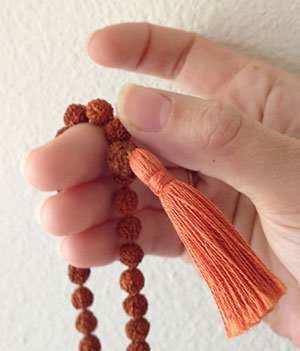
Instructions for morning sadhana [spiritual practice]: Do one [japa] mala [round on your prayer beads] before getting up in the morning. Then do pranayama [yoga breathing], do a few bends [stretches, flexing], take a small walk. Now sit relaxed. You must be relaxed, especially the cheeks and hands. Sit up[right] in a straight line. The head, neck, shoulders should be in a straight line and the chin must be in line with the shoulders. You must be comfortable. Now repeat OM three times, [taking it] from the navel to the top of the head, and beyond that to the soundless.
Open with the prayer Guru brahma . . . Dhyana . . .
[see footnotes 1 and 2].
Visualise the Ishta Devata from the feet upward, slowly – not as flesh, but as light. Feel the light flow from His [or Her] feet, to bless you. Move up his legs, thighs, tummy, hands, arms. Dwell for about 5 minutes on His moon [shiny, effulgent] face. Look at it, part by part, especially the eyes. See His [facial] expression. He must be smiling sweetly, calmly at you.
If there is no form, imagine you are the infinite ocean – above and below – an ocean of light – or infinite sky. When the mind is settled, begin the silent repetition of the mantra [sacred syllable, word or one of the many names attributed to God]. Do this with love, with bhava [feeling, intensity]. Repeat the mantra of the Ishta Devata. If the mind wanders, be like a father, bring it [gently] back again and again.
Think, ‘I am happy in body, I am happy in mind.’ Offer the fruit [merit] of your sadhana to the Guru [spiritual Preceptor] and to God. Offer day and night to Guru and God. At the end repeat the mahamantra [see footnote 3] twice, and, ‘Namaami twam aham devim [stotram from the Devi Atharvashirsha. See footnote 4],’ twice. Repeat a few other slokas [scriptural verses].
Do you feel irritatable after meditation? Go for a walk. Be in mauna [voluntary silence of mind and speech] sometimes, or repeat the guru mantra 16 times. If someone knocks [on your door] and disturbs you? Turn away or just smile. Imitate [follow the example of] the Guru with the heart wide open. Worship Ganesha [the aspect of God that removes obstacles], Hanuman [the great devotee of Lord Rama].
Afterwards get up with the same peace you had in meditation, open your eyes, see your Ishta Devata in everything. Ask God to give you love to worship Him and to repeat His name.
FOOTNOTES:
[1] Guru mantra: The Guru Brahma Mantra (also known as the Guru Stotram or Guru Vandana) is a sacred Sanskrit chant in Hinduism that honours the spiritual teacher [Guru] as the embodiment of the divine trinity [Trimurti] and the supreme reality.
गुरुर्ब्रह्मा गुरुर्विष्णुः गुरुर्देवो महेश्वरः ।
गुरुः साक्षात् परं ब्रह्म तस्मै श्रीगुरवे नमः ॥
Transliteration (IAST):
Gurur Brahmā Gurur Viṣhṇu Gurur Devo Maheśvaraḥ |
Guruḥ Sākṣhāt Para Brahma Tasmai Śrī Gurave Namaḥ ||
Meaning: Guru Brahma: The Guru is Brahma, the creator. Guru Vishnu: The Guru is Vishnu, the preserver. Guru Devo Maheshvaraḥ: The Guru is Shiva (Maheshvara), the transformer or destroyer. Guruḥ Sākṣhāt Para Brahma: The Guru is the direct, tangible manifestation of the Supreme
Brahman (the absolute, infinite reality). Tasmai Śrī Gurave Namaḥ: Salutations and surrender to that revered Guru.
[2] Guru Dhyana Mantra.
ध्यानमूलं गुरुर्मूर्तिः पूजामूलं गुरुर्पदम् ।
मन्त्रमूलं गुरुर्वाक्यं मोक्षमूलं गुरूर्कृपा ॥
Transliteration (IAST).
Dhyāna-mūlam gurur-mūrtiḥ pūjā-mūlam gurur-padam;
Mantra-mūlam gurur-vākyam mokṣa-mūlam gurūr-kṛpā
Meaning: Dhyana Mulam Gurur Murtih: The form (murti) of the Guru is the root or foundation of meditation – dhyana. Focusing the mind on the Guru’s form helps steady concentration.
Pooja Mulam Gurur Padam: The feet – padam – of the Guru are the root of worship – puja. Bowing or surrendering to the Guru’s feet symbolises humility and respect.;
Mantra Mulam Gurur Vakyam: The spoken word – vakyam – or instruction of the Guru is the root of all mantras. The Guru’s advice carries the power of a sacred chant.
Moksha Mulam Guru Kripa: The grace – kripa – of the Guru is the root of liberation – moksha, leading the seeker to final spiritual freedom and peace.
[3] Maha Mantra:
Hare Rama, Hare Rama, Rama, Rama, Hare, Hare.
Hare Krisha, Hare Krishna, Krishna, Krishna, Hare Hare.
[4] Tvameva Mata Mantra from the Pandava Gita.
त्वमेव माता च पिता त्वमेव ।
त्वमेव बन्धुश्च सखा त्वमेव ।
त्वमेव विद्या द्रविणम् त्वमेव ।
त्वमेव सर्वम् मम देव देव ॥
Transliteration:
Tvameva Mātā Ca Pitā Tvameva
Tvameva Bandhuśca Sakhā Tvameva
Tvameva Vidyā Draviṇam Tvameva
Tvameva Sarvam Mama Deva Deva
Tvameva Mātā Ca Pitā Tvameva: You alone are my mother and father.’
Tvameva Bandhuśca Sakhā Tvameva: You alone are my relative and friend.’
Tvameva Vidyā Draviṇam Tvameva: You alone are my knowledge and wealth.
Tvameva Sarvam Mama Deva Deva: You are my everything, O God of gods.
Underlined words are hypertext links to clarification, explanation or other sources. Just tap on them.
The free-to-read or download, 396-page Flipbook version of Swamiji’s biography, ‘A Life Lived For Others‘, is available by clicking HERE. If you’d prefer the PDF version, please click HERE.
For our gurubhai Atmaprakash Kramer’s beautiful pictorial ‘memoir’ booklet of the Ramakrishna Centre of South Africa, Avoca Ashram, please click HERE.
There’s also a Facebook site for Swamiji’s posts now. They feature newer readings published more recently. Click HERE to view.
These recordings or the excerpts from them, were made from the early 1970s onward, by Mother Radha, a close devotee of Swamiji’s and edited for uploading here by our gurubhai and her son, Brother Tim. Please be mindful that what Swamiji was saying may have been specific to those with him at the time.