Swamiji explains the powerful role of Lord Ganesha in our spiritual lives. Disc 146 – track 1a.
When you remove the obstacles to spreading dharma, this dharma is today spreading. This is one verse that he [not sure who Swamiji is referring to] quotes very often, that ‘Truth is one and sages call it by various names.’ [Ekam Sat Vipra Bahudha Vadanti – Rig Veda 1.164.6]
So you find in the scriptures that wherever people are suffering – in that particular group, in that particular area, again He [God] comes. Sometimes this great Being is straightaway identified as God himself, like in the case of Sri Ramakrishna. Otherwise, you’ll find that these great Beings, later on, after they’ve left earth, [only then do] people begin to see the highest manifestations of all the positive qualities, and thus they identify him with the Supreme Being.
Sri Ramakrishna Bhagavan didn’t initiate anybody. That is what you must always remember, top of your mind. What did Ramakrishna do? Ramakrishna just touched and the fire got on [started]. The fire of spirituality. So, initiation can be told like this: There’s a fire, it’s smoking and he takes this big [blow] pipe – you know they call it phukni. Swamiji makes blowing sounds, that’s what the guru does too. [Indistinct section on recording] Sometimes it [the flame] goes up and sometimes it goes down. He blows … sometimes afterwards, the disciple … sometimes it goes [flares up].
But Ramakrishna didn’t do this. Ramakrishna was a great Incarnation [maha avatara], like [Lord] Krishna himself said to Arjuna, ‘Look, behold! And Arjuna saw the whole glory [of Lord Krishna in his Vishwaroop aspect]. He didn’t initiate him to see it. Ramakrishna said, ‘Awake Mother! Awake!’ And when he said ‘Awake!’, the man straightaway found himself in a superconscious state, which Hindus call samadhi.
When Christ said, ‘Behold!’ people looked and saw the glorious light of God. So they didn’t initiate. They just said [spoke] and it happened. The others [gurus] blow [to get the flame going].
There’s those people who blow – God’s got no ego – you’ll never find that God says, ‘I’ve got disciples.’ That’s why every time someone referred to Sri Ramakrishna Bhagavan as ‘Guru’, he’d say, ‘It’s burning words you’re telling. I’m not the guru. Only Satchidananda himself is the guru.’ Ordinary people [gurus] have chelas [disciples] so they [may] become automatically egoistic gurus. They have the ego of calling others ‘chelas’. But this has to be clear in your mind about Sri Ramakrishna Paramahamsa. He was the Avatara, therefore he’s God.
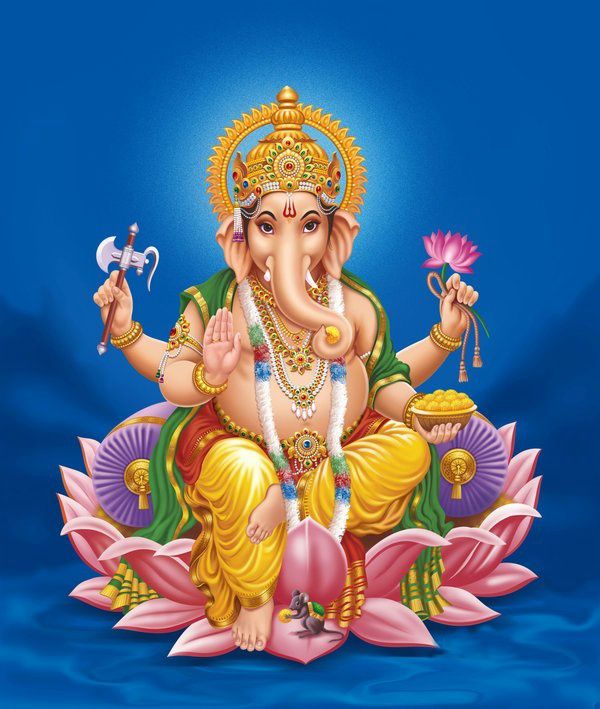
When he initiated a disciple, Swami Vivekananda – you know what instruction Vivekananda did [gave]? He said, ‘You know, Ganesh Bhagavan [Lord Ganesha] is the god of the sannyasins [renunciates, monks, nuns], the brahmacharis. So first what you must do, he told them, is close your eyes and pray to Ganapati – Ganesh Bhagavan. And then, meditate on me [my form] and merge me in Ganesh Bhagavan and then merge Ganapati [another name for Lord Ganesha] Bhagavan in Sri Ramakrishna. So Ramakrishna becomes the symbol of all the deities.
Let’s take it like this. Ramakrishna is the ocean, Swami Vivekanandaji is the river, and Ganapati Bhagavan is the starting point – like the drops of water – that slowly pushes [streams] into the river and the river merges in the ocean. Like that. But don’t ever make a mistake that Ganapati is so small the way I’m saying it. It’s not a small river. The yogis say Ganapati – Ganesh Bhagavan, is seated in the Muladhara Chakra – Mul-a-dhara. Mul – the main one. The main chakra is right down. [In the subtle-body area of the perinium between anus and genitalia of the human body]. So Ganesh Bhagavan’s seat is that. Until Ganesh Bhagavan pierces the Kundalini shakti, until Ganesh Bhagavan agrees for the Shakti [power] to go – it’s hopeless. It can’t happen.
So, what do we understand about this? Now, sitting in the Kundalini, Muladhara means the main, most important, it means the primal strength, the initial strength. In the beginning there was the Word, and the Word was with God, and the Word became flesh [Christian Bible John 1:1 – 14]. So in the beginning, before anything, you will find that this ‘Word’ was Ganesh himself, Ganesh Bhagavan, in the beginning. He was the first prime mover in any work whatsoever – even in the work of God himself. Just as you say ‘God’ and think of God with form, then God [too] must have a Kundalini. So he’s [Ganesha] the prime mover in that. The Muladhara chakra. The universal Muladhara chakra. Now if that part is understood, then we go forward.
Where does the authority come from to worship Ganapati Bhagavan? In the Shukla Yajurveda you find this mantra. [This mantra is an invocation to Lord Ganesha, often referred to as the Ganesha Suktam mantra, found in the Rig Veda (Mandala 2, Hymn 23, Mantra 1, and parts of the 8th and 10th Mandalas]. Swamiji chants the mantra – some of the congregation join in. ‘Om gaanaatwaa ganapati gung havaamahe; Priyaanaantwaa priyapati gung havaamahe; Nidhinaantwaa nidhipati gung havaamahe; Vaso mama aham ajaani garbhadamaatwam ajaasi garbhadham.’ Loosely translated: We propitiate that Lord of all beings and groups, Ganapati, who is the repository of love, and prosperity. May He reside in our hearts.
Now in the Shukla Yajurveda you find this mantra. It straightaway rules out that this is a Tantric god. God has not found its place in the Vedas. So it’s a Vedic god. It is said now if we just translate the meaning of this straight away, it says, Om Gananaam, Ganapati. ‘What is your name?’ ‘Your name is Ganapati. Gana naam.’ That is the Sanskrit. You are Ganapati, your name is Ganapati and you are my beloved. You are my beloved in everything. You are not the beloved only in man, you are the beloved of the gods themselves. Gods worship you. Man worships you. And not only that, you’ll find in the Puranas that it says [indistinct] You are the giver of the nine kinds of bhakti. You give O Ganapati Bhagavan. So, he is the giver. So I call you O Lord, come and take your seat here in my heart. O Lord, protect me – that is the meaning of that mantra. Ends.
The free-to-read, 396 page Flipbook version of Swamiji’s biography is available by clicking HERE.
These recordings were made from the 1970s onward, by Mother Radha, a close devotee of Swamiji’s and edited for uploading here by our gurubhai and her son, Brother Tim. Please be mindful that what Swamiji was saying may have been specific to an individual or a group of people with him, at the time.