Talk Excerpt 689 and 690 combined. Swamiji explains the power of Mother Ganga.

From Mother Radha’s recordings of Swamiji.
Mother Ganga has looked after thousands of Rishis who lived on her banks from time immemorial. She gave darshan to Mother Parvati, moksha to the ancestors of Sage Bhagirathi, and to many people after that.
We have faith in Mother Ganga because Sri Ramakrishna himself had her vision and darshan. He himself used to worship her. And in keeping with Sri Ramakrishna’s experience we invoke that all-pure, all-love, life-giving and liberation-giving shakti-goddess in the form of Mother Ganga. The Master said that Mother Ganga is the flowing Brahman.
May she bless us, though we are far away from that visible form of hers – the sacred river Ganga. But the purifying power that is in her, is also in us. We also have purity; and that part of Ganga we evoke is in us. May that Ganga, which is the power of purity, purify our lives and give us moksha. May she come here in her subtle form and partake of the prasad that we offer to her, with love, faith and devotion.
Devotee: Must we see the Master [Sri Ramakrishna] in our Ishta Devata or vice versa? Swamiji: The understanding is that all the devatas must be seen in Sri Ramakrishna and not Sri Ramakrishna in them. In chapter eleven in the Bhagavad Gita it is said that everything was seen in Sri Krishna – not that Sri Krishna was seen in them.
But I say to you, from my little knowledge, Sri Ramakrishna can be seen inside your deity too. Just as your soul is your Ishta Devata, Sri Ramakrishna is your Ishta Devata’s soul. Sri Rama was outside and yet Sri Rama was inside Hanumanji. How was it that he was without, and yet he was within?
But Sri Ramakrishna said: ‘Meditate on me as Kali and think that you are Shiva.’ That is how he explained it to a disciple. And you can change that, according to your relationship with him.
Excerpt 690: Suppose I am a Shiva worshipper and I love Lord Shiva, what I do is I place Sri Ramakrishna in my head as my guru, and then I imagine Lord Shiva in my heart. I then take Lord Shiva up to the head and merge Sri Ramakrishna in Lord Shiva. I am still worshipping Shiva.
Gurur brahma gurur vishnu gurur devo maheshvarah; Gurur sakshat param brahma tasmai sri gurave namah. Meaning: The Guru is Parambrahma, the absolute reality; and the guru is Brahma, Vishnu, Mahesh [Lord Shiva] all merged in One. Sit down and meditate – nothing excluded, all included.
Sri Krishna says he exists eternally; he is the past, present and future. Truth can neither be changed nor taken away at any time.
That which you call ignorance does not exist at all times. It ceases to exist when knowledge dawns. God never ceases to exist.
Maya only means: wrong concept – that which is not [‘Partial truth’ as Swamiji often described it to us]. And that which is not, is what you are looking at. Though you are looking at it, it is not the absolute truth. It is like a mirage. You think that there is water over there, but there is none.
You are thinking that you are the body, but in reality you are not the body. God, the Reality, dwells in the body. Look at your Real Nature and the body vanishes – you see everything as Spirit.
There are different levels of consciousness. We only see the physical aspect, as revealed by the senses. There is a higher state of consciousness where the holy man, the Realised Soul, sees everything as Brahman – which is its real, eternal state. That is all.
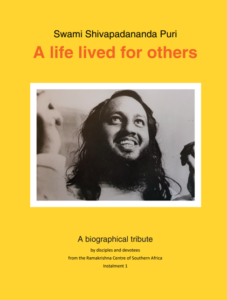
The free-to-read or download, 396-page Flipbook version of Swamiji’s biography, ‘A Life Lived For Others‘, is available by clicking HERE. If you’d prefer the PDF version, please click HERE.
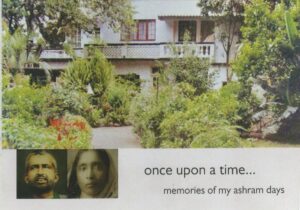
For our gurubhai Atmaprakash Kramer’s beautiful pictorial ‘memoir’ of the Ramakrishna Centre of South Africa, Avoca Ashram, please click HERE.
These recordings or the excerpts from them, were made from the early 1970s onward, by Mother Radha, a close devotee of Swamiji’s and edited for uploading here by our gurubhai and her son, Brother Tim. Please be mindful that what Swamiji was saying may have been specific to an individual or a group of people with him, at the time.