Talks Excerpts 491 & 492 combined. Swamiji uses Kshudiram Chattopadhyay – Sri Ramakrishna’s father – as an example of righteousness under all circumstances.
From Mother Radha’s recordings of Swamiji.
Sri Rama said: Raghukul riti sada chali aayi . . . This means, ‘My life can go, but I will never give up truthfulness and my promise.’
The householder’s [Grihasthi] basis – his morals, his character – should be truthfulness in whatever he or she does. Standing on righteousness or sincere intention, discharge your duties.
As we start practising this we will find that we become fit instruments to give our all – not to get attached more and more [to secular things] but rather to get detached.
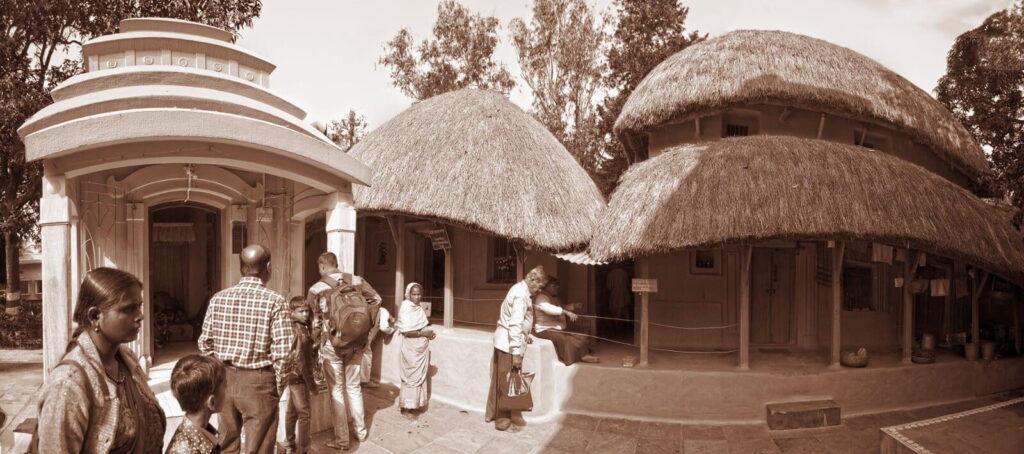
Sri Ramakrishna’s father [Kshudiram Chattopadhyay] had one great virtue and quality: he never spoke an untruth. It was because of his truthfulness that he [lost his ancestral land] was driven out of his own village. [Click HERE for that story.] Sri Ramakrishna could not, even absent-mindedly, do that which dharma did not permit.
[Swamiji frequently reminded us of this important story]: Once, a doctor told Sri Ramakrishna, ‘Come, I’ll give you some medicine.’ Sri Ramakrishna went to the dispensary but the doctor was absent and so the manager gave him the medicine. He took it and walked away. As he was going along, all he could see was a blank. He could not see the road back to the Dakshineswar Temple. He thought, ‘What’s happening?’ Then a thought came in his mind: He had said he was going to take the medicine from the doctor, not from the manager. So, with this guileless thought he threw the medicine back into the dispensary and when he looked again he saw the road was clear.
Even absent-mindedly Sri Ramakrishna could not do or say anything that was adharmic.
Householders must live a life of moderation. In the Bhagavad Gita Sri Krishna said that he who eats a lot cannot be a yogi. (You are all trying to be yogis.) He who fasts over-limit and thinks that the gods will get happy, he will never be a yogi. He who does not sleep at all, cannot be a yogi and he who sleeps a lot also cannot be a yogi. He who indulges in sense pleasures (without moderation) can never be a yogi – he can never know God.
Even the wealth that is accumulated through dharmic action may be wasted if the senses rule you. In the Bhagavad Gita it is said: ‘Even the wise man, O Arjuna, is carried away by his turbulent senses.’
[Talks Excerpt 492 combined because it follows on]: For us to have a clearer vision of these virtues we must do rituals. As we do rituals we pray to God in a specific way for His compassion, His love, His everything. We try to behave selflessly in our daily actions, and from outside we come closer, we come inside.
Then we do those selfless actions universally instead of only doing them in the shrine. We serve others without even reminding ourselves about it.
We try not to tell lies. Again and again we remind ourselves: ‘God is truth. I must do truthful things outwardly, no matter how my mind is trying to revolt.’ Then inside it becomes our character. Character means that subconsciously or habitually we will be doing things without any effort. First it is voluntary action, later on it will become involuntary [automatic] action because we think of this in a universal sense.
What is the reason for being moral? Why can’t we rob, plunder and steal? For the simple reason that we want to become perfect instruments to know the Universal Spirit – to get what we call God-realisation. After getting It, you have no need of anything else.
Jesus the Christ said: ‘First seek ye the kingdom of God and everything else shall be added unto it.’ Matthew 6:33.
How is it that the Rishi’s light account is paid though he does not go to work? How is it that he sits in the cave and gets his food? He just projects a thought, and somebody comes along with food. After knowing It, even worldly things are abundantly provided.
Now comes the parent’s responsibility. In the brahmacharya ashrama the child should not be exposed to any sensual things. His mind should be on a higher level at all times. Tell him the stories of the great saints and sages. Bring to his mind all the positive things.
Use the word ‘don’t’ very little, if at all. Always use ‘do’. ‘Do this, do this, do this.’ [Suggest a positive alternative]. ‘Do what Prahlada did.’ ‘Do what Dhruva did.’ ‘Do what Shravan Kumar did.’ Do. Do. Do. Be active.
The free-to-read or download, 396-page Flipbook version of Swamiji’s biography is available by clicking HERE. If you’d prefer the PDF version, please click HERE.
These recordings or the excerpts from them, were made from the early 1970s onward, by Mother Radha, a close devotee of Swamiji’s and edited for uploading here by our gurubhai and her son, Brother Tim. Please be mindful that what Swamiji was saying may have been specific to an individual or a group of people with him, at the time.