Talks Excerpt 462. Swamiji speaks on mauna, and Sri Ramakrishna ‘transcending’ the then-perceived boundaries of Hinduism.
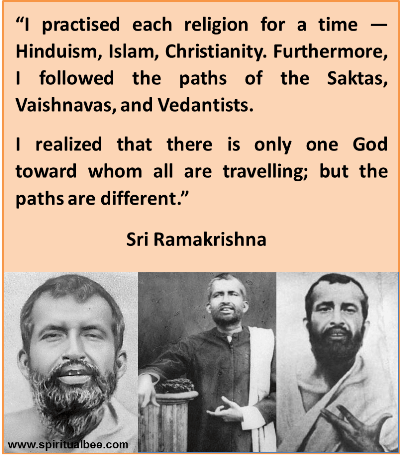
From Mother Radha’s recordings of Swamiji.
Mauna does not only mean that only your mouth must be closed, it also means that your mind must not be speaking. Actually, nobody can be in [full] mauna except a God-realised man.
You may be observing silence but at the same time you may be thinking about lots of things. That is not mauna. To write the mantra and think about it means you are not completely in mouna. But we say one is in God, who is all-mouna because you are thinking of God.
At the time of Shankaracharya the term ‘Jagat Guru‘ meant only the guru of India. When Sri Ramakrishna came he included the whole world – America, Africa and so on.
In Shankaracharya’s time Christianity and Islam were not spoken of, but Sri Ramakrishna included these world religions in the Hindu fold. Because of this many people say Sri Ramakrishna transcended Hinduism.
The Vedas spoke of India alone. Shankaracharya said at that time that only Brahmins could realise God. The Kshatriyas and Vaishyas were included to a certain extent, but not the low castes. Yet in the life of Sri Rama we find Guha included. Sri Rama embraced him and others.
You will find that we have become prejudiced into thinking that we are the only custodians of this great religion. Through practice Sri Ramakrishna showed that the whole world is jagat. And jagat actually means, ‘The world which changes.’ And where in this world is there a non-changing thing?
The free-to-read or download, 396-page Flipbook version of Swamiji’s biography is available by clicking HERE. If you’d prefer the PDF version, please click HERE.
These recordings or the excerpts from them, were made from the early 1970s onward, by Mother Radha, a close devotee of Swamiji’s and edited for uploading here by our gurubhai and her son, Brother Tim. Please be mindful that what Swamiji was saying may have been specific to an individual or a group of people with him, at the time.