Talks Excerpt 745 to 747 inclusive. Swamiji explains why abortion is forbidden in the Sanatana Dharma. And describes subtle training of sadhakas.
From Mother Radha’s recordings of Swamiji.
Excerpt 745:
Swamiji sings: ‘O Mother mine, make me Thine, make my life divine…..’
You can become divine only by sacrificing that which is not divine. That which is not divine is called lower self. That which is Absolutely Divine is called the Higher Self. Thus, sacrificing the self in the Self, one is established in the Higher Self.
In spiritual life there are two things we must balance: one is responsibility; the other is personal upliftment.
Supposing I have to serve five people who are dying. Who knows how important it is for me to look after them? If my mind says, ‘Go and meditate,’ I must refuse it and rather look after these five people. My reasoning is that out of those five people, we don’t know who is going to be a saint.
From that point of view even abortion, in our [Sanatana Dharma] religion, is forbidden. Once again it is because we don’t know what the child – if it is born – will be like. Or how it is going to help the world.
[I so wish someone had asked Swamiji about possible ‘exceptions’. For example: What if the mother’s life is in danger with epclampsia or some other medical condition? If there’s a significant foetal abnormality, or the pregnancy is the result of rape/incest? But, unfortunately, they didn’t. So, a reminder that what Swamiji said was frequently specific to the people with him at the time.]
If, in the beginning stages, a sadhaka’s mind says, ‘Go and meditate,’ what he should say to his mind is, ‘Work is also a way of meditation because it is karma yoga.’ But if his mind is dry, if he doesn’t have the feeling of religiousness then it is better to go and meditate. (Work should not be an excuse to ignore meditation.)
But the way we should train our minds is to see everything in renunciation and renunciation in everything. Like seeing everything in God and seeing God in everything.
Therefore our gurus say that we must watch our mind; be sure that it doesn’t become bogged down only in meditation; only in karma yoga; only in raja yoga. It must be sharp and alert. At will, you must be able to detach and attach. At will. So therefore you program yourself. Supposing I have ten sadhakas with me and at karma yoga time one of the sadhakas says, ‘I want to go and meditate.’ I will not allow him to go and meditate at that time. I will say, ‘No, you do this karma yoga first.’ I’ll say this until such time as I see he is not attached to sitting and meditating.
Excerpt 746:
Yes, sitting and meditating can bring about calmness, but if by standing and being active you can have that calmness, then I will allow you to go and sit to meditate. It is not an objective thing; more a subjective thing. You have to watch yourself and weigh [evaluate] yourself.
If you want to sit in meditation, you should go and meditate; but at the same time don’t neglect the other aspects of spiritual life. I can’t give you a hard and fast rule, because you are your own judge. No one else can be your judge.
When I was in India somebody came into the ashram and he sat the whole day; he just wanted to meditate. But his meditation was of a very tamasic nature. He didn’t want to do any karma yoga. Sadhakas must watch their minds. Your mind must be able to attach and detach at a moment’s notice, then you can listen to your mind.
Thakur [one of Swamiji’s brahmachari attendants at the time] makes me laugh sometimes. At night I’ll say, ‘Come on, press my leg’. [Swamiji had almost constant leg muscle spasm as a result of genetic Charcot Marie Tooth syndrome]. He will do that for a little while, then he will moan and say, ‘Swamiji! I want to go and sleep.’ In order to make him strong and not give in to the laziness of his mind, I coax him to go on serving. Then when he does not grumble anymore, and is calm, I send him to sleep. He thinks I am fooling. I am not fooling. I am strengthening his mind. All this is training – though you may not understand it.
Excerpt 747:
When I wanted to go to the movies, my father used to say no. Then at the end of the year, he would be the one to give me money and say, ‘Go to the movies.’ I have come to know now that it was a kind of training. God trains you from young. But we tend to revolt against training and discipline – given by the parents, or through the school teacher. All that is spiritual training. Nothing was out[side] of spirituality.
First: Morality. No teacher will teach you to be immoral. Actually, by the time we pass our degrees, we should be moral, even in our worldly environment. We think the spiritual side should only be left to spirituality. But it is not so. We are still struggling to nurture the seed of morality.
But Swami Turiyanandaji [a direct monastic disciple of Sri Ramakrishna] says, ‘Too much of work [karma yoga] is not good if you have a dry feeling.’ Yes, do sadhana and do work, but at the same time don’t neglect other aspects of life.
Suppose you have to get up at four o’clock in the morning because ten people are waiting in the shrine for you, but instead you are busy with other activities. You are neglecting God in the form of the sadhakas. After all, God is the actor in everything. Isn’t it so? He came as a sadhaka but you are neglecting Him.
Sri Ramakrishna’s mind was free. He lived happily. His actions were so simple. But we do not treat his life and teachings seriously. If you take a resolution you must remember it. A strong will is manliness and when you have not kept your vows it indicates weakness. Take up the challenge. Strengthen the positive. Root out the weeds in you. Be more positive, and weakness will disappear by itself.
Whatever little good you do will bear good results. Therefore try intensely not to do anything adharmic (immoral or unrighteous).
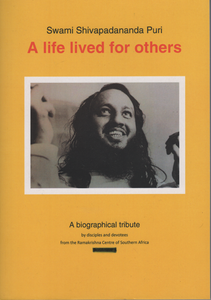
The free-to-read or download, 396-page Flipbook version of Swamiji’s biography, ‘A Life Lived For Others‘, is available by clicking HERE. If you’d prefer the PDF version, please click HERE.
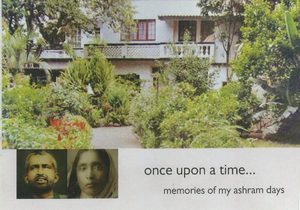
For our gurubhai Atmaprakash Kramer’s beautiful pictorial booklet, ‘Memories of my ashram days‘ at the Ramakrishna Centre of South Africa, Avoca Ashram, please click HERE.
There’s also a Facebook site for Swamiji’s posts now. They’re for newer readings published much more recently. Click HERE to view.
Audio recordings or the excerpts from them, were made from the early 1970s onward, by Mother Radha, a close devotee of Swamiji’s and edited for uploading here by our gurubhai and Radha Ma’s son, Brother Tim.
Please be mindful that what Swamiji was saying may have been specific to an individual or a group of people with him, at the time.