Swamiji says that everything – from the tiniest worm to the highest angel, must one day realise God. Disc 133 track 4.
To listen to Swamiji speaking, please open the post, and then click HERE.

Swamiji is speaking about Swami Vivekananda’s famous line of ‘Service to man is service to God.’ He breaks it down for us to understand the depth of the meaning behind the statement – instead of just taking it at superficial, face value.
Swamiji quotes Swami Ranganathananda [the 13th President of the Ramakrishna Math and Mission – pictured below] on the dual benefit of this approach. Says our Swamiji: So that you’re evolving inside, and you’re also evolving outside.
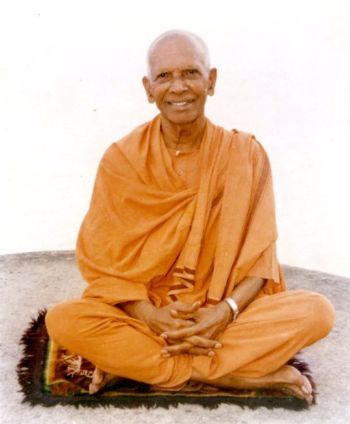
Swamiji talks about a beautiful aspect of ‘mind’ which we mistakenly attribute only to humans. Swami Vivekananda said that everything – from the tiniest worm to the highest angel, must one day realise God. Swamiji says something which has given him great comfort, is the statement: ‘Just as the sinner has a long future, so the saint has had a long past.’
Says Swamiji: A dog has a mind, a cat has a mind. [Swamiji chuckles] – an ant has got mind, too. [But as Swamiji told us, insects are part of a ‘group consciousness.’]
Swamiji continues a previous thought, which is Sri Ramakrishna saying that ‘As many minds, so many religions’. So, says Swamiji: there must be billions of religions [paths to God-realisation].
In answer to a devotee, Swamiji again reinforces the important point, that nature itself will force the evolution of all levels of consciousness.
Swamiji continues sharing profound philosophical insights. Switching gears, he says that many books give information on geography, science, and other topics but the Bhagavad Gita is the only book that deals with the knowledge of knowledge itself. So Vedanta deals with ‘what is the Self?’ or what is Consciousness?
Swamiji speaks of the danger of immature minds attempting to interpret spiritual teachings, without knowing the nature of the Self, and thus becoming free of the different methods. And one of the methods is through institutions [ashramas and the like].
Swamiji talks about the Paramahamsa state. The Paramahamsa doesn’t stay in ashrams. You can put him anywhere really, says Swamiji – even in a lavatory, and he’ll still be happy.
Swamiji quotes Swami Vivekananda, saying that ‘It’s a sin to die in a church.’ Swamiji and the devotees laugh, the latter perhaps not yet grasping the coming point, which is not in the recording. [But Swamiji always used to say to us, quoting Swami Vivekananda, ‘It’s fine to be born in a church but you shouldn’t die in one.’ Or for that matter, in a temple, mosque, shul or the same place, wherever it may be. Meaning that regardless of our religion, we must evolve significantly above and beyond where we started off.]
Swamiji wraps up the discussion by talking about the difference between secular knowledge and studying for the sake of having the information, as opposed to studying to grow spiritually.
The free-to-read or download, 396 page Flipbook version of Swamiji’s biography is available by clicking HERE. If you’d prefer the PDF version, please click HERE.
These recordings or the excerpts from them, were made from the early 1970s onward, by Mother Radha, a close devotee of Swamiji’s and edited for uploading here by our gurubhai and her son, Brother Tim. Please be mindful that what Swamiji was saying may have been specific to an individual or a group of people with him, at the time.