Swamiji discusses Incarnations [Avatars] of God, in detail.
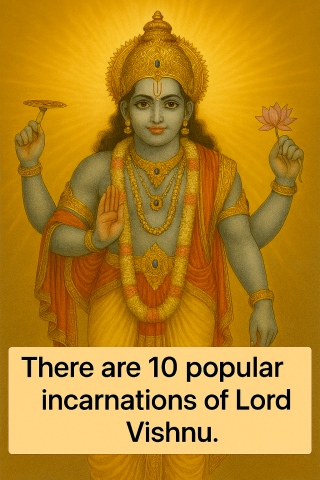
Swamiji says that God comes in a particular form and when he does so, he corrects all the misconceptions about himself.
He destroys only one thing – and that is, ignorance, or what we call adharma [unrighteousness].
In its place, he gives knowledge. Knowledge is that light, which disperses the darkness of ignorance within the being – within man himself.
The Hindu scriptures speak of ten [dashavatara] popular or primary avatars [Incarnations of God] of Lord Vishnu.
Swamiji spells them out, mentioning that the tenth one, Kalki, is still to come. Swamiji says that the Bhagavatam tells of another twenty five of these avatars, in addition to the 'popular' ten avatars.
The Lord himself qualifies it even further in the Bhagavatam by saying that his incarnations are infinite – because he himself is infinite.
Swamiji says to understand it, the ten avatars are incarnations of Lord Vishnu. What we learn is that God doesn't only become man, he can dwell as [Here are the Sri Vishnu Incarnations to date:] 1) Fish in water, as 2) Tortoise in water and on land. And the 3) Boar can roll in the mud or water, but also live in the forest.
Then you get the 4) Narasimha avatar who can live as a man, and at the same time [as a lion] in the animal kingdom. Then he can live as a perfect man – as a 5) Dwarf – a 'cute kind of person' says Swamiji. Then as 6) Parashurama – who destroyed the Kshatriyas [warrior caste]. Because at that time the Kshatriya kings were full of arrogance and pride and he came to correct them.
Then came 7) Rama who lived as civilised man. A prince, who perfectly executed his duty to all, as an example, role-model and as Lord of the age.
Next is 8) Krishna, the perfect avatar – with the full manifestation of all the 16 powers or kalas of the Supreme Being, God. Swamiji says that Lord Krishna's diversity/complexity/versatility makes him difficult for anyone without a pure mind, to fully understand.
Then came 9) Buddha – the perfect free soul. He showed man how to live without getting caught in any concept. He was once asked, 'Must we worship God?' and his answer was, 'Just be good and do good.' He went against the scriptures, the Vedas, because the Brahmins [priests and teachers] at that time had created a religion which was very ritualistic. And people were getting bored and tired – because if you didn't have money to buy the ingredients for, and then perform the rituals, it was a 'you won't enter the kingdom of heaven' type of mentality which prevailed. So Buddha put an end to that.
To learn much from this discussion, please click on the link below. Jai Sri Ramakrishna!
Duration: 08:56
Click here for the Flipbook version of: → Swamiji's biography
It's a free-to-read, draft 396 page, extended version of 'A Life Lived For Others. No need to install a PDF reader. It'll work in your present browser.
However, if you'd prefer a straight-up PDF version, please click HERE.
Dear Devotee, if we use the term 'He or he', when referring to Swamiji, it's not impolite or disrespectful. It's to minimise the repetitiveness of saying or writing 'Swamiji' too many times.
The original audio recordings of these posts were made by close Ramakrishna Centre of South Africa and Swami Shivapadananda devotee, Mother Radha. The audio editing and noise reduction of the original 1970s-onwards tapes, has been lovingly engineered, over many years, by her son and our dear gurubhai, Brother Tim. May Sri Ramakrishna and Swamiji bless them both.
Admin tip: Underlined words are links. If you click on them, they'll take you to an explanation of the particular word or term. [In these overviews, Admin comments are typically in a smaller green font, and square bracketed, like this statement.]
Dear reader, if you spot typos or or other errors, please feel free to email the site admin on info@imbizo.com with your suggested correction/s.
Context: As always, care should be taken to remember that what Swamiji was saying, was often very specific to the needs of people with him at the time. Please bear this in mind.
Links to our Guru Parampara (spiritual lineage) organisations, which will broaden your knowledge base: Ramakrishna Math and Mission and our alma maters, the Ramakrishna Centre of South Africa and the Sri Sarada Devi Ashram in Durban. The Ramakrishna Centre of Johannesburg is also active in Gauteng province in South Africa.
There are various publications [The Gospel of Sri Ramakrishna etc.] which you can download at no charge, from the Ramakrishna Centre of SA website page, HERE.
The visual in today's post was crafted using prompts to Microsoft Copilot Artificial Intelligence (AI).