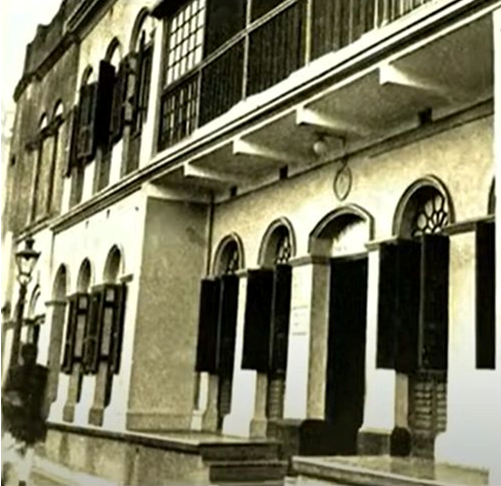
Disc 135 Track 5. Swamiji shares some glorious insights into Holy Mother’s life at Udbodhan House.
To listen to Swamiji speaking, please fully open the post and then click HERE.
Swamiji is speaking about a devotee reading from the Mahabharata [in the Udbodhan House where Holy Mother occupied some living space] to the Holy Mother Sri Sarada Devi. On conclusion of the reading, Holy Mother salutes [means: places hands together in prayer position, lifting them to forehead and bowing the head] the book. Swamiji emphasises that this is the kind of respect we should all follow and show for venerated objects, books and the like.
In the reading, Holy Mother gives advice to the devotees about the need to always be engaged in some work or duty. Swamiji says this is good for both body and mind. [Swamiji used to tell us that the idle mind is the Devil’s playground. The ‘Devil’ being the impure mind.] Here, speaking to one of the monastic disciples present, Swamiji gives advice about the need for sannyasis [monks] to be engaged in ego-reducing work. Swamiji says they should not too regularly visit people, as that can lead to attachment. ‘Visit people when they’re sick and need comfort’, says Swamiji. ‘Not just for TV and to engage in idle chat.’
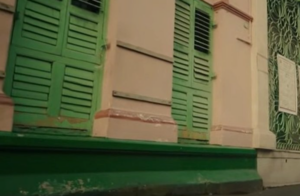
For context, before the next part of the reading: Udbodhan House or Mayer Bari (‘the Mother’s House’ as it’s often referred to) in Bhagbazar in then Calcutta, was built across the road from a large slum. Holy Mother was able to see the slum from the building and had a full view of it from the outside rooftop where she used to dry her hair, after bathing in the nearby river Ganga. She one day even shouted from there at a man who was beating his wife. He stopped instantly! To watch a YouTube video in which the first part gives a history of Udbodhan House, click HERE.
‘Seeing good even in evil’ is the next portion of the reading. It’s the story of a man from outside of Bengal who lived with his mistress in that very same slum opposite Udbodhan House. The woman had become seriously ill and Holy Mother expressed her admiration for him and the way he took care of her, to the devotees. In the reading it says that [particularly in those days] it would have been very easy ‘to turn up one’s nose’ at the idea of a couple ‘living in sin’ as it used to be called. But here, Holy Mother saw beyond that, to the extraordinary love and dedication that the man had for his partner.
The reading also tells of an old woman, also from the slum, arriving with a sick child in her arms, asking for Mother’s blessings. The writer says: Mother was gracious to that child. She said that the child would soon recover, and blessed it, and of course it did recover.
Swamiji then says that what is offered in the shrine by devotees, should be shared or given by the sannyasis as prasad for everyone. Not just for themselves.
The reading goes on to the death of Girish Chandra Ghosh, the famous Bengali playwright who was a disciple of Sri Ramakrishna, and from whose unique relationship with Master, we have learned so many lessons. If you don’t know the story of the alcoholic and debauched Girish meeting Sri Ramakrishna and yet ending his life as a saint, click HERE and scroll to the 14th paragraph, starting with ‘A few days after…’.
Girish asked Sri Ramakrishna to be born as his son. Although Sri Ramakrishna appeared to dismiss the notion, after Sri Ramakrishna’s passing, a mute [non-verbal] or autistic son was born to Girish. The boy didn’t speak at all and communicated by gestures only. When the child turned four years of age, he somehow conveyed that he wanted to see the Holy Mother. Girish took him to Udbodhan House to see Mother. Girish felt utterly unworthy of seeing the Mother,but the boy pulled him into the room to greet Her. The child passed away shortly afterwards, still aged four. A delightful Ramakrishna lila, if ever there was one.
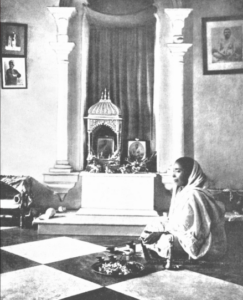
Swamiji ends the reading by briefly addressing the concept of ‘Guru vada’ or respecting and upholding the Guru’s name, reputation and tradition. Says Swamiji, practise what we tell you. Don’t go and boast about it.
The free-to-read or download, 396 page Flipbook version of Swamiji’s biography is available by clicking HERE. If you’d prefer the PDF version, please click HERE.
These recordings or the excerpts from them, were made from the early 1970s onward, by Mother Radha, a close devotee of Swamiji’s and edited for uploading here by our gurubhai and her son, Brother Tim. Please be mindful that what Swamiji was saying may have been specific to an individual or a group of people with him, at the time.