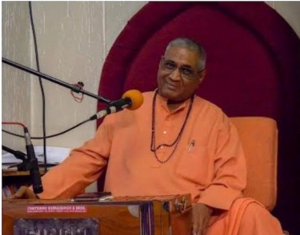
Disc 135 Track 6. Swami explains that with the repetition of certain mantras, there are rules to obey.

To listen to Swamiji speaking, please fully open the post and then click HERE.
Swamiji warns about the role of ego and the need to give credit, where credit is due.
He then gives advice on doing Japa [repetition of a mantra, sacred sound syllable, or word]. Swamiji always used to tell us that there are three levels to it. An external repetition – out loud. Then whispered. Then silent and internally – ‘in the heart’.
Here, Swamiji tells how Holy Mother Sri Sarada Devi told one of the monks – to his horror – that he should repeat his mantra out loud so everyone would be able to hear him. This would normally be 180 degrees the opposite of an instruction from the Guru.
Only years later did the monk confess that he’d felt shame about doing Japa – and Mother’s advice eliminated that feeling. Swamiji quotes Lord Krishna in the Bhagavatam as saying that shame is one of the obstacles to spiritual progress.
However, Swamiji talks about the ego-building risks of repeating a mantra out loud, because people might admire our supposed ‘holiness’. From His chuckles, Swamiji is clearly having fun with this.
He uses the analogy of a father giving money to his children and talks about the benefit of having sufficient ‘money’ – bhakti [divine love and devotion] within us, so that we can also share and give some of that bhakti to others. Some people will have just enough money to maintain only themselves, but not others. And yet others, despite having a lot of money, will not be able to maintain even themselves.
Swami explains that with the repetition of certain mantras there are rules to obey [some have restrictions on who may repeat them or who is supposed to hear them and the like]. But with the Maha Mantra [Hare Rama, Hare Rama, Rama Rama, Hare Hare, Hare Krishna, Hare Krishna, Krishna Krishna, Hare Hare] there are no rules to obey. Swamiji says it’s a ‘rule-less’ mantra, therefore it’s called the ‘Maha’ [great] mantra. Any caste, any colour, and creed can repeat it. ‘The best part of that mantra’ says Swamiji, is that you can meditate on Rama, you can meditate on Krishna, you can meditate on God without form with that mantra. It covers all three aspects in one.
Swamiji talks about how to go from external vocalisation to silence and gives the example of a bee. It buzzes and makes a noise so long as it’s flying about, but when it sips nectar, it’s silent.
Swamiji is in a merry mood. He tells of someone who told him that mouni sadhus [non-speaking or silent monks] are the best kind. Swamiji said, ‘You’re right. That’s why Ved Vyasa put it all in writing.’ But Swamiji was joking, and said that writing is a form of speaking too.
Swamiji says every Hindu should do Sandhya rituals. Some will do it without knowing why – maybe just because their forefathers did it. Sometimes, why they do it, they don’t know.
Swamiji tells a story about being at the Ganga near Rishikesh and an old man wearing only a sack to cover his body, was moving about. Says Swamiji: People were going into the ashramas in the vicinity to prostrate, but an old man said, ‘Rather go and prostate to him. He’s a Siddha Purusha’. Swamiji says they did indeed prostrate to the apparent ‘madman’, who uttered some words of blessing. Says Swamiji: We don’t meet mahatmas. They meet us.
Swami Premananda Puri – Swamiji’s disciple and our beloved Gurubhai.
Swamiji talks about what we’d ask of God if He appeared before us. He quotes our beloved Gurubhai Swami Premanandaji Puri as saying that his acharya [teacher] gurus at Kailash ashram, Rishikesh, said to a well-known and admired philanthropist devotee, ‘You’re doing all these good things for others – but what are you doing for yourself? [On the spiritual development front].
This is an important segment to listen to and for us to pay attention to the caution. Inappropriately directed altruism can degenerate into ego-driven social work, when it’s not accompanied by personal spiritual practise and development.
Swamiji tells the [true, by the way, as confirmed by Swamiji] story of young graduand in the USA, who on stage, was handed his degree certificate but tore it up in front of everyone. They asked him why he did that. He agreed to explain, but only if he could do so on microphone to the whole audience. They allowed him to do so.
His words were, ‘I struggled so hard. I wrote my thesis – I’m now supposed to be an educated man. I’ve earned this certificate. But up to today, I’m not peaceful. It has not made me any happier. I still have the same troubles in my life that I had when I was ignorant of all this knowledge.’ Says Swamiji – this was a real happening. It’s like Hanumanji breaking the mala [click HERE for the story]. It’s the truth. We’re all doing so many things, but let us look at how much we’ve done for ourselves [Not in a selfish way.] In the Christian Bible in Matthew 16:26 and parallel verses like Mark 8:36 it reads: ‘For what is a man profited, if he shall gain the whole world, and lose his own soul?’ This powerful saying from Jesus highlights that all earthly gain -wealth, success, power, or pleasure – is ultimately worthless if it comes at the cost of one’s own spiritual progress and relationship with God]. It’s a big question, says Swamiji. How much have we done?
Swamiji draws the threads of the conversation together by concluding with the anecdote told by Sri Ramakrishna commenting on people taking a bath in the river Ganga. Swamiji says that Shastric tradition says that your sins will fly away when you immerse yourself in the Ganga. But Master said that the sins merely perch on the surrounding tree branches and as the supplicant emerges from the river and their minds are overtaken with worldly thoughts again, the birds fly back to settle on their shoulders. [Much merriment from Swamiji and the devotees at this.]
Swamiji says the same thing applies to us doing katha and jhanda and other prayer services, when we don’t approach them with the right attitude.
The free-to-read or download, 396 page Flipbook version of Swamiji’s biography is available by clicking HERE. If you’d prefer the PDF version, please click HERE.
These recordings or the excerpts from them, were made from the early 1970s onward, by Mother Radha, a close devotee of Swamiji’s and edited for uploading here by our gurubhai and her son, Brother Tim. Please be mindful that what Swamiji was saying may have been specific to an individual or a group of people with him, at the time.