Talks Excerpt 351. Swamiji says: Nothing is too great to give to the Guru.

From Mother Radha’s notes, written at Swamiji’s feet.
Find out who ‘I’ is – and then you will find out who you are.
You are not the body-mind complex. You are the Atman.
Worship the Guru in your heart, with water, milk, flowers, fruit, whatever you like, morning and evening. Then even if you cannot be with him all the time, clinging to his feet, you can cling to him in your heart. Then the body becomes the living temple of God.
Devotion to the Ideal [Ishta Devata] is devotion to the Guru, and devotion to the Guru is devotion to the Ideal. If you sincerely devote yourself to practising the yogic principles laid down in the scriptures, you must make spiritual progress.
Cling to the Ideal, become an ideal person. Practise all that the Ideal stands for. The Ideal will be pleased. The Ideal is God: you chose it and so you become God too. You must see God in the Ideal, otherwise it is useless.
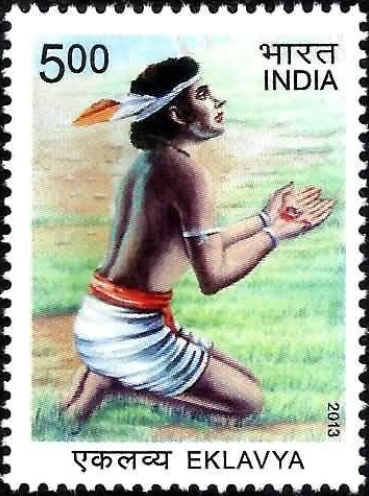
The story of Ekalavya illustrates this. He was a poor man from the forest but he asked Dronacharya, the great archery teacher, to be his guru. Dronacharya refused. So Ekalavya went to the forest and made a crude image of Dronacharya in clay and worshipped him as his Guru. He then practised archery for a long time in front of this form of the guru.
In the meantime Dronacharya had promised Arjuna, his student who excelled in archery, that no one would be better than him. Thus Arjuna would be his best student. One day, Ekalavya came out of the forest and at a competition beat Arjuna. Naturally Arjuna became angry. Dronacharya was in a fix, so he went to ask Ekalavya, ‘Who is your guru?’ The man said, ‘You are.’ Dronacharya said that he never taught him archery. Then the man explained how he made the image and learnt archery.
Dronacharya cleverly demanded guru dakshina from him. Ekalavya said, ‘I will give you what you want.’ The Guru demanded his right thumb [so the man would be unable to use a bow and arrow again] and immediately the man from the forest cut off his thumb and gave it to his Guru.
Ekalavya’s story shows us that nothing is too great to give to the Guru. Be humbler than a blade of grass. If you feel that ‘I am a disciple,’ be humbler, become nothing. Praise the Guru in your heart.
[The fuller story, as excerpted from Wikipedia, is here:
Ekalavya (Sanskrit: एकलव्य, romanized: ekalavya, also spelt as Eklavya) is a character from the Hindu epic Mahābhārata. He is described as a young prince of the Nishadas, a confederation of forest and hill tribes in ancient India. The son of Hiranyadhanus, a king of the Nishada tribe, Ekalavya seeks to learn archery from Dronacharya, the royal teacher of the Kuru princes, including the epic’s main protagonist Arjuna. However, Dronacharya refuses to accept him as a disciple due to his Nishada background, as well as the potential to surpass the Kuru princes. Ekalavya trains himself in the forest using a clay statue of the teacher as his guide. His exceptional skill attracts the attention of Arjuna, who, feeling threatened, complains to Dronacharya. In response, Dronacharya demands Ekalavya’s right-hand thumb as guru dakshina (teacher’s fee), which Ekalavya willingly gives, diminishing his abilities.]
The free-to-read or download, 396 page Flipbook version of Swamiji’s biography is available by clicking HERE.
These recordings or the excerpts from them, were made from the early 1970s onward, by Mother Radha, a close devotee of Swamiji’s and edited for uploading here by our gurubhai and her son, Brother Tim. Please be mindful that what Swamiji was saying may have been specific to an individual or a group of people with him, at the time.