Swamiji explains how the mind needs positive habits for our spiritual benefit.
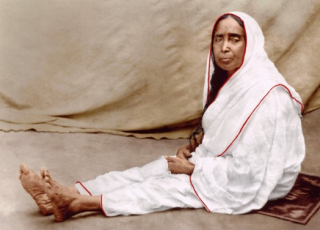
Pictured: Holy Mother, Sri Sarada Devi in bodily old age.
Swamiji illustrates how the mind gets caught in habit. He gives the example of how, when he was in India (which was three hours ahead of South Africa, time zone wise), his tummy would rumble for lunch when he normally ate it. But it was only 9am India time!
He goes on to say that Sri Ramakrishna and other saints and sages have said that habit (regularity) is essential to spiritual progress. Swamiji says that if one is really tied down by pressing, unavoidable life responsibilities, then any time to think about God or meditate will do. He says, 'Snatch it!' But his stress is on how regularity makes the process easier, and delivers greater benefits.
Swamiji talks about spiritual vibrations and how the full moon gravitational pull affects some people. [Admin: Swamiji used to say to us that if the full moon creates high tides in the ocean, can you imagine what it's doing in the human brain? – which according to science, is composed of approximately 75% water.] He says that at early morning (Brahmamuhurta), midday, very early evening, and midnight, the mind will be beneficially influenced by Mother Nature's cyclically-driven and calming vibrations at those times.
Please listen to Swamiji giving the devotees several examples to emphasise the need for regularity in our minds and lives. He says sincerity is required. Because otherwise we just keep making excuses about why we can't do regular sadhana (spiritual practise or meditation). He says a medical doctor will go and open his surgery at a specific time every day, because it's important to him and his patients, but we're obviously not prioritising God, if we don't do a similar thing.
Swamiji shares the amusing story of how he started off his early-days sadhana practise with a japa mala (prayer beads) – pictured.
 He used 'baby steps' (my words) to get the mind to co-operate. Hear how he explains his technique for doing this. He says he found it 'very, very, very helpful'. Please note the repetition of 'very'. This is a powerful recommendation.
Swamiji says that if we can't work towards pleasing the physical form of the Guru, how on earth are we going to develop love for the formless (non-physical)? He uses the example of not listening to the Guru's words, which are supposed to be a mantra, and therefore obeyed. He references a bank-balance to illustrate his point. [It's quite scary to hear what we're doing, or not doing to ourselves, spiritually.] Swamiji goes on to talk about the mis-use of the Guru's grace, and how the Spiritual Preceptor will 'put his foot down' at some point, to teach the sadhaka a tough, but love-driven lesson.
Someone asks about whether we should bathe or shower before doing sadhana, early in the morning. Swamiji shares what Holy Mother, Sri Sarada Devi used to do. A great idea for us to emulate.
Swamiji wraps up the discussion session with a challenge. He says if we're doing meditation, we'll have questions resulting from it, to ask the Guru. As he says, 'No questions, means no meditation is being done.'
To listen to this inspiring recording, please click on the link below.
Jai Sri Ramakrishna!
Duration: 07:12
The original audio recordings of these posts were made by close Ramakrishna Centre of South Africa and Swami Shivapadananda devotee, Mother Radha. The audio editing and noise reduction of the original 1970s tapes has been lovingly crafted, over many years, by her son and our dear gurubhai, Brother Tim. May Sri Ramakrishna and Swamiji bless them both.
Admin tip: Underlined words or words in colour, are links. If you click on them, they'll take you to an explanation of the particular word or term.
Dear reader, if you spot typos or or other errors, please feel free to email the site admin on info@imbizo.com with your suggested correction/s.
Links to our Guruparampara (spiritual lineage) organisations, which will broaden your knowledge base: Ramakrishna Math and Mission, Ramakrishna Centre of South Africa, Sri Sarada Devi ashram, Durban.