Swamiji speaks on the unifying, integrating nature and impact of Sri Ramakrishna.
Says Swamiji: In the Vedas [ancient Hindu religious texts], Truth is ONE. But the sages call it by different names. Not only call it by different names but worship it in different forms.
Because if I call God 'Marigold' [the flower] I have to worship God in the form of a Marigold.[Name and form are inextricably interlinked. You can't think 'apple' and at the same time visualise an elephant]. The same with a Rose. Marigold and Rose don't look the same, although both are flowers. Both are what?…truth.
So from there, you find that Ramakrishna Bhagavan had the vision of ALL the different deities. And he never condemned one way of worship – the worst worship he didn't condemn. But he did say that in this yuga [epoch, era, age], one should definitely be careful what kind of worship is performed.
Sattvic worship is the best worship, while the other worships are still worship. Someone may ask, 'What is sattvic worship?' – it's with bhakti [devotion and love] of course. Tamasic worship is where they slaughter a goat, use brandy etc.
The next, Rajasic worship, you call together a lot of people, you have katha and janda,[festivities, raise a flag, feed the people] and people often rate the prayer as a social event. Pride gets you – you become happy. Then someone criticises your Pandit [the officiating priest] – and you get upset. It activates your mind.
Sattvic, you don't care whether anyone knows or not. Your mind is calm. With love, you meditate on God. You don't care whether the world acknowledges it or not. But with the other forms of worship, you must watch it. You want people to praise you. You want people to think what a holy man you are. But a [truly] holy man will be concerned only with himself and his God.
Swamiji explains how Sri Ramakrishna gave impetus to Satsang as a means for spiritual development. He didn't go on a stage, but went to people's homes. He went house to house. Even at the Ramakrishna Centre, says Swamiji, we shouldn't care so much about stages, but rather go to individual homes and there, have a little satang.
Swamiji jokes about Sri Ramakrishna's enjoyment of Jalebi at people's homes. [It's also said to have been Lord Rama's favourite sweetmeat.]
Swamiji speaks about diet, vegetarianism and what happens as one evolves spiritually. He speaks about smoking or drinking, and how to let go of these habits. He explains how to do this by using God's name and God-thought. please listen to the detail. [It's a delightful tool for mind-management.] The discussion includes the 'value' of God's name. Swamiji says the best thing we can do in Kali Yuga, is to cling to God's name.
Swamiji speaks about the unifying role of the Incarnation [Avatar] given the exclusivity and sectarian nature of religious society at the time. Sri Ramakrishna came and worshipped them all, as being different manifestations of that ONE Being, the supreme Brahman, God Himself.
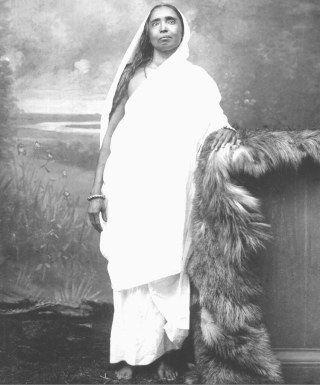
Sri Ramakrishna uplifted women. Other sannyasis [monks] had an aversion approach. What did Ramakrishna do? He kept his own wife [Holy Mother Sri Sarada Devi] with him, and worshipped her as Mother Jagadamba. By worshipping her, you can also get God. Listen to Swamiji explaining Sri Ramakrishna's advice to one of his monastic disciples, [later known as] Swami Turiyananda.
Swamiji says Sri Ramakrishna turned the negative concept of 'don't', into the positive of 'do'.
Swamiji draws the thread of the narrative together by explaining that Sri Ramakrishna devotees have no sectarian differences. No conflict with anyone. He says, so long as we have faith, carry on! Only a God can inspire people the way Sri Ramakrishna did. And he, himself admitted who he was.
Swamiji concludes with a deeply affecting anecdote about Swami Vivekananda telling Sri Ramakrishna to ask the Divine Mother to allow him to eat a little food, when his throat cancer made it practically impossible. There's a powerful lesson here, for all of us.
To listen to these life-altering words, please click on the link below. Jai Sri Ramakrishna!
Duration: 11:43
Click here for the Flipbook version of: → Swamiji's biography
It's a free-to-read, draft 396 page, extended version of 'A Life Lived For Others. No need to install a PDF reader. It'll work in your present browser.
However, if you'd prefer a straight-up PDF version, please click HERE.
Dear Devotee, if we use the term 'He or he', when referring to Swamiji, it's not impolite or disrespectful. It's to minimise the repetitiveness of saying or writing 'Swamiji' too many times.
The original audio recordings of these posts were made by close Ramakrishna Centre of South Africa and Swami Shivapadananda devotee, Mother Radha. The audio editing and noise reduction of the original 1970s-onwards tapes, has been lovingly engineered, over many years, by her son and our dear gurubhai, Brother Tim. May Sri Ramakrishna and Swamiji bless them both.
Admin tip: Underlined words are links. If you click on them, they'll take you to an explanation of the particular word or term. [In these overviews, Admin comments are typically in a smaller green font, and square bracketed, like this statement.]
Dear reader, if you spot typos or other errors, please feel free to email the site admin on info@imbizo.com with your suggested correction/s.
Context: As always, care should be taken to remember that what Swamiji was saying, was often very specific to the needs of people with him at the time. Please bear this in mind.
Links to our Guru Parampara (spiritual lineage) organisations, which will broaden your knowledge base: Ramakrishna Math and Mission and our alma maters, the Ramakrishna Centre of South Africa and the Sri Sarada Devi Ashram in Durban. The Ramakrishna Centre of Johannesburg is also active in Gauteng province in South Africa.
There are various publications [The Gospel of Sri Ramakrishna etc.] which you can download at no charge, from the Ramakrishna Centre of SA website page, HERE.
The image of Holy Mother Sri Sarada Devi is taken from the Ramakrishna Math Chennai, verified original pictures site, HERE.