Swamiji speaks on incarnation ‘styles’ and Sri Ramakrishna’s birth in detail.
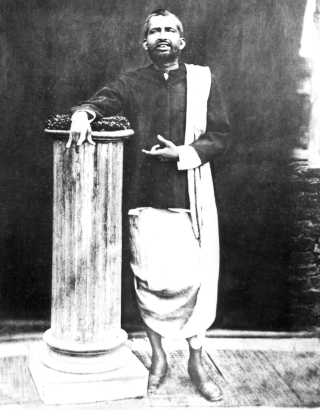
So when God comes, he comes to take away all the unnecessary things and to give the essentials of religion.
In this avatara [incarnation], [Adi] Shankaracharya, came into this world, a great Rishi [sage, seer, saint], a great sannyasi. He established the 10 orders of sannyasa [Dasanami Sampradaya] and he was very intellectual.
And on the other hand, when Chaitanya Mahaprabhu came, he was very very….what?….emotional. But in between these two, which you must have, is Ramakrishna himself. They call him Rama and Krishna. And to me it just means this: that Rama is the devotional type and Krishna is the intellectual type. So in between these two – and to unite these two – you must have somebody. And who else can unite that – who else knows better, but he who has given us those two? [as previous avatars].
So Master [Sri Ramakrishna] said [when close to attaining mahasamadhi – consciously leaving the body] – to then Naren, Swami Vivekananda] 'He who was Rama, and he who was Krishna, is Ramakrishna' [and He added 'and not in your Vedantic sense'].
Swamiji explains perceptions and personality-preference expectation conflicts among devotees, which might have occurred in those previous incarnations. [As in secular life, 'one size doesn't fit all' – so in spiritual life, devotees will often be attracted to a particular personality style, type or manifestation.]
Faith was being lost in the ancient deities [gods]. What was needed was head and heart. So who came? Ramakrishna. Ramakrishna is very pure. Not born out of a sexual act, but out of pure devotion and love. When his mother became pregnant, she was in her late 50s, almost 60.
Swamiji tells the story of Gadadhar's [Ramakrishna's boyhood name] father being away from *Kamarpukur, in Gaya for Preta Karma and his Mother [Chandramani Devi] witnessing the aarti to Lord Shiva in the evening. She saw many little lights dancing around the Shiva Lingam. All the lights suddenly combined, and in one blaze entered into her body. She fell down and was carried to her room. She then immediately felt, as Swamiji puts it, that she was 'in the family way'. *[For some beautiful photographs of Master's Kamarpukur birthplace – with added modern structures now in place, click HERE.]
[There may well be an understandable cynicism by westerners, when it comes to the idea of non-sexual, 'virgin' birth stories. But Hindus or Sanatanis will be very comfortable with the idea that the Divine is not bound by human biological limitations when incarnating in human bodies. If we accept that 'God' or a divine consciousness is omnipotent, omnipresent and omniscient, then, logically, we must accept that it can do whatever it chooses, however it chooses, and wherever it chooses. In the field of yoga philosophy, this wouldn't even be up for debate. Whether one accepts this possibility – or as Sanatanis see it – actuality – or not, whether with the Lord Jesus' birth or that of Sri Ramakrishna – it should not become the disruptor or issue getting in the way of anyone's spiritual development or faith. Acceptance of or belief in 'miraculous' conception is not a pre-requisite for spiritual advancement. Let the devotee choose what's comfortable or fits at the time – and it may progressively unfold and reveal other levels of insight, later.]
At the same time, whilst in Gaya, Khudiram Chattopadyaya [Gadadhar's father] was asleep, and he dreamt that Lord Vishnu came and said, 'I want to take birth in your house.' Khudiram said, 'Please don't come to my house, I'm so poor already. Who's going to look after you? You need a lot of things.' The Lord responded by saying, 'Don't worry, I'll look after my own material needs.' In that case said Khudiram, you can come.
And the Lord said, I am under the tree. When Khudiram woke up, he saw a cobra under a nearby tree. And beneath the cobra, was a round Saligram/Shaligram [fossilised] stone – a symbol of Lord Vishnu. Khudiram prayed, the cobra quietly slithered away, he collected the sacred stone, and returned to Kamarpukur. On arrival, he told Chandramani Devi about his experience, and she shared hers.
Shiva represents knowledge, intellect and renunciation, and here, Vishnu stands for bhakti – love and devotion. So the two aspects were already united and thus, Ramakrishna was born.
Swamiji tells the story of Gadadhar's [Sri Ramakrishna's] boyhood sight of white cranes flying against a dark sky and how he became ecstatic and went into samadhi [a superconscious state].
People had lost faith in murti [image] worship. And Sri Ramakrishna worshipped Mother Kali. He conversed with and cried to Mother Kali. And Mother Kali emerged from the murti [in the Dakshineswar temple] . He found there was no murti – but Mother Kali herself. He even put his hand beneath her nose to check for breath, and she was indeed breathing.[Swamiji told us that Mother's murti in the temple is alive, to this day.]
Swamiji draws the threads of the homily together by sharing how Sri Ramakrishna validated the status and role of Lord Jesus as an incarnation. He tells the story of a Christian priest visiting Master, who told him to go and see 'Mother' in the Dakshineswar Kali temple. The priest goes, and returns, puzzled. 'There's no Mother there', he said. Master asked, 'Who did you see? He answered, 'Jesus Christ.'
Master sent him back again to see 'the Mother'. The priest looked at the murti of Mother Kali yet again, but saw only his Lord Jesus Christ. And the third time he was sent back, Sri Ramakrishna blessed him with a vision that let him realise that She who is Kali, is also His Lord Jesus the Christ.
To be thrilled by this intense lesson, please click on the link below. Jai Sri Ramakrishna!
Duration: 07:58
Click here for the Flipbook version of: → Swamiji's biography
It's a free-to-read, draft 396 page, extended version of 'A Life Lived For Others. No need to install a PDF reader. It'll work in your present browser.
However, if you'd prefer a straight-up PDF version, please click HERE.
Dear Devotee, if we use the term 'He or he', when referring to Swamiji, it's not impolite or disrespectful. It's to minimise the repetitiveness of saying or writing 'Swamiji' too many times.
The original audio recordings of these posts were made by close Ramakrishna Centre of South Africa and Swami Shivapadananda devotee, Mother Radha. The audio editing and noise reduction of the original 1970s-onwards tapes, has been lovingly engineered, over many years, by her son and our dear gurubhai, Brother Tim. May Sri Ramakrishna and Swamiji bless them both.
Admin tip: Underlined words are links. If you click on them, they'll take you to an explanation of the particular word or term. [In these overviews, Admin comments are typically in a smaller green font, and square bracketed, like this statement.]
Dear reader, if you spot typos or or other errors, please feel free to email the site admin on info@imbizo.com with your suggested correction/s.
Context: As always, care should be taken to remember that what Swamiji was saying, was often very specific to the needs of people with him at the time. Please bear this in mind.
Links to our Guru Parampara (spiritual lineage) organisations, which will broaden your knowledge base: Ramakrishna Math and Mission and our alma maters, the Ramakrishna Centre of South Africa and the Sri Sarada Devi Ashram in Durban. The Ramakrishna Centre of Johannesburg is also active in Gauteng province in South Africa.
There are various publications [The Gospel of Sri Ramakrishna etc.] which you can download at no charge, from the Ramakrishna Centre of SA website page, HERE.