Talks Excerpt 425. Swamiji says: With constant japa bad thoughts do not arise.
From Mother Radha’s notes, written at Swamiji’s feet.
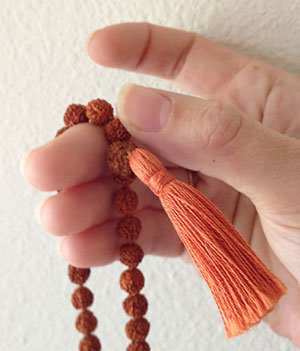
Go on repeating the mantra given to you by your guru. But desire is such that you think: ‘Let me leave this Deity and try another one.’ You will never get it like that. The mantra given you by the guru is the master key – it opens any lock. You should repeat it first for 108 times [one mala].
You will see it for yourself, that with constant japa bad thoughts do not arise. This is very, very important. Think good, good, good – and not bad, bad, bad. Some people have nothing to worry about, but they create new worries.
Go on brooding over the Lord. Sorrow and suffering cannot be avoided. Gunas are continually changing. When you are dealing with others, remember: I am always changing.
A good man is he who knows his own shortcomings. It makes him more stable.
[During an Upanishad class Swamiji said]: The highest concept is found in the Upanishads, so we should not neglect the study of them. They are scriptures by studying which, one can and must realise Brahman. Yogis always study and reflect on them – and meditate on them. If a man does this, his mind remains pure at all times. And the Upanishads become like a sea full of bliss; and the jiva dives into that ocean. Each time it comes out it is strong, pure and refreshed.
We do particular rites [and rituals] to overcome the asuras (bad qualities or unrighteous people). If you want to be a good man, overcome the asuras, do more sadhana – otherwise you are an asura. You look like a human being but you are an asura. Become divine through sadhana.
The free-to-read or download, 396-page Flipbook version of Swamiji’s biography is available by clicking HERE. If you’d prefer the PDF version, please click HERE.
These recordings or the excerpts from them, were made from the early 1970s onward, by Mother Radha, a close devotee of Swamiji’s and edited for uploading here by our gurubhai and her son, Brother Tim. Please be mindful that what Swamiji was saying may have been specific to an individual or a group of people with him, at the time